
In modern organizations, managers carry one of the most demanding roles. They are expected to deliver results, motivate teams, solve problems, and execute strategy at the same time. Yet many managers struggle because expectations are unclear, priorities keep shifting, and performance discussions become emotional rather than objective. This is why key performance indicators for managers have become an essential foundation of effective management.
When designed properly, KPIs do far more than track numbers. They clarify responsibilities, align managers with business strategy, and create a fair system where performance is measured transparently. When designed poorly, KPIs become a source of stress, resistance, and internal conflict. The difference lies in the methodology behind them.
Why Key Performance Indicators for Managers Are So Critical
Managers act as the bridge between strategy and execution. Senior leadership defines direction, but managers turn those plans into daily actions. Without clear key performance indicators for managers, even the best strategy will fail at the execution stage.
Well-designed managerial KPIs provide three essential benefits. First, they translate abstract goals into concrete outcomes. Managers know exactly what success looks like. Second, they create focus. Instead of reacting to everything, managers prioritize activities that truly drive results. Third, they establish accountability without micromanagement. Managers are trusted to deliver outcomes, not just complete tasks.
In organizations without strong KPIs, managers often feel trapped. They are busy all day, but performance reviews remain vague. Feedback becomes subjective, and reward decisions feel unfair. Over time, this erodes trust and motivation.
The Most Common KPI Mistakes Managers Face
Many companies claim to use KPIs, but few implement them correctly. One common mistake is copying KPIs from other organizations without considering context. Another is overloading managers with too many indicators, causing confusion instead of clarity.
A more serious issue is misalignment. Some managers are measured on activities rather than outcomes. Others are rewarded for departmental targets that conflict with company profitability. For example, a manager may hit efficiency targets while quality drops, or achieve revenue growth while cash flow deteriorates.
True key performance indicators for managers must reflect how the business actually succeeds. They must balance results, processes, people, and long-term sustainability. Without this balance, KPIs encourage the wrong behaviors.
Managers as KPI Leaders, Not KPI Victims
KPIs should never be something that “happens to” managers. Instead, managers must become KPI leaders. When managers understand how KPIs are designed, how scores are calculated, and how results link to rewards, they shift from resistance to ownership.
This mindset change is crucial. Managers stop defending themselves during performance reviews and start using KPIs as a coaching tool. Conversations move from blame to improvement. Teams become more engaged because expectations are clear and progress is visible.
This transformation does not happen through software alone. It requires structured alignment, education, and ongoing support.
How sandmerit KPI 123 Is Fundamentally Different
Many solution providers focus on one part of the KPI puzzle. Some sell KPI software but leave clients to figure out strategy and behavior change on their own. Others deliver training workshops that sound inspiring but fade once people return to daily work.
sandmerit KPI 123 is different because it was designed to make key performance indicators for managers work in real-life organizations, not just on slides or dashboards. It is a complete, integrated solution built on three powerful stages.
The first stage focuses on strategic clarity. Through CEO one-to-one coaching, company vision, strategic priorities, and reward philosophies are clearly defined. Manager KPIs are then designed to support these strategies directly, ensuring alignment from the top.
The second stage is the sandmerit KPI workshop. This is where managers and teams gain true understanding and buy-in. KPIs are explained in practical terms, not theory. Managers learn how KPI scores are calculated, how performance links to company profitability, and how rewards are distributed fairly. This stage removes fear and resistance, especially among middle managers.
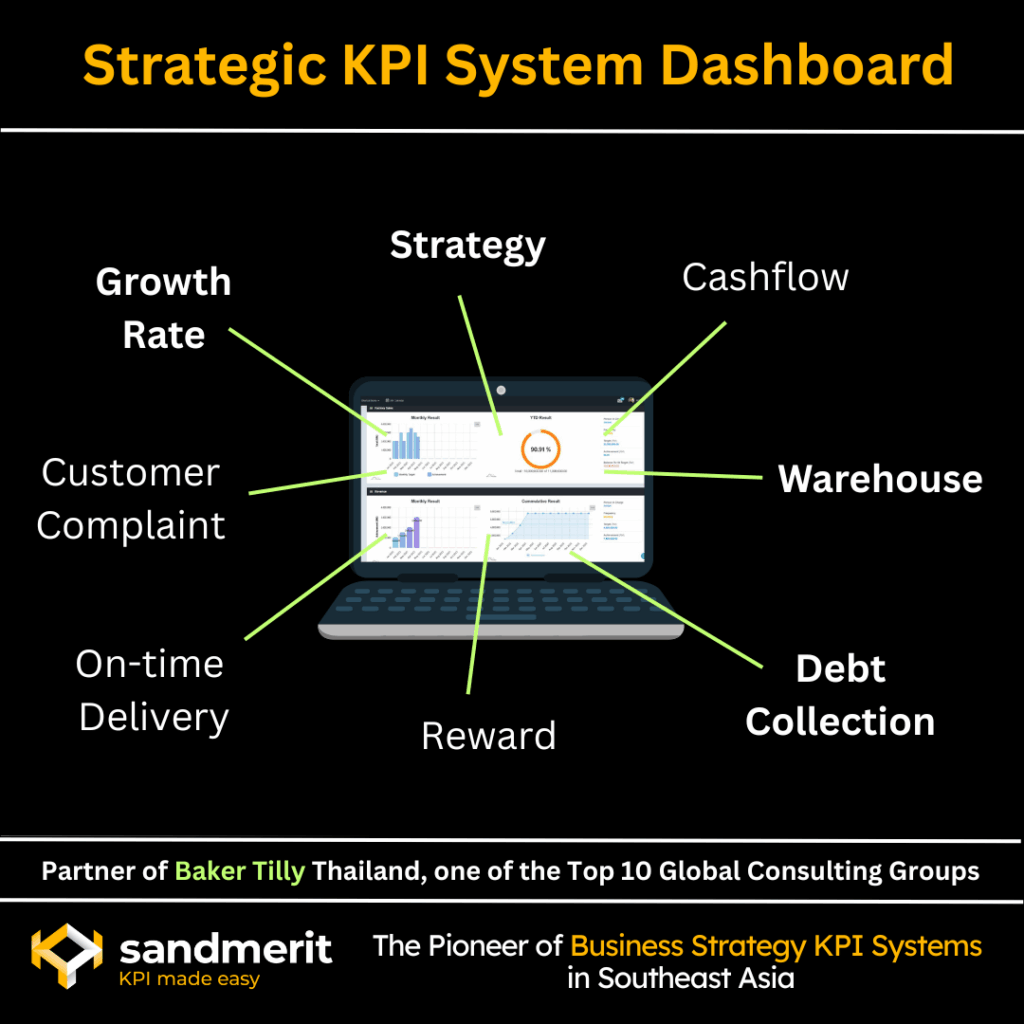
The third stage is system automation. sandmerit provides a robust KPI system that covers all departments, not just sales. Managers track progress using real data, not opinions. Scores are generated transparently, reducing conflict and bias. Most importantly, the system supports execution, not just reporting.
sandmerit continues to support clients after implementation, ensuring KPIs evolve as the business grows.
A Practical, Data-Driven KPI Framework
sandmerit’s approach to key performance indicators for managers avoids subjective ratings that damage trust. Instead of vague scoring, KPIs are designed with clear achievement schemes and measurable ranges. Managers know exactly what level of performance leads to which score.
KPIs are structured using the Balanced Scorecard perspective, ensuring that managers focus on financial results, internal processes, customer outcomes, and people development. This prevents short-term optimization that harms long-term performance.
Reward systems are also carefully designed. Performance rewards are linked to both KPI scores and company results, creating a fair and sustainable distribution mechanism. Managers and employees understand that rewards are earned, not negotiated.
The Wilson Ten Advantage
The strength of sandmerit lies not only in its system, but also in the experience behind it. Wilson Ten, widely known as the KPI King in Malaysia, brings more than 21 years of hands-on performance management experience.
Wilson has worked with SMEs, multinational corporations, and public-listed companies across Southeast Asia. He is not an academic theorist. He is a practitioner who has helped organizations improve productivity, restore fairness, and turn losses into profits through structured KPI systems.
As Chairman of the Professional Committee of International KPI Standards, Wilson also contributes to shaping international best practices. His unique strength is his ability to gain buy-in from both CEOs and employees. Even frontline operators can understand how KPIs connect to profitability and rewards under his guidance.
This people-centered, execution-focused philosophy is what makes sandmerit stand out in a crowded market.
From Measurement to Meaningful Management
At their best, key performance indicators for managers are not about pressure or control. They are about clarity, fairness, and growth. Managers gain confidence because expectations are clear. Employees feel respected because performance is measured objectively. Leaders gain peace of mind because execution is visible and aligned.
sandmerit believes that KPIs should keep people inspired, not intimidated. By integrating strategy, alignment, systems, and rewards into one coherent framework, sandmerit KPI 123 turns KPIs into a powerful driver of business success.
For organizations that want KPIs to deliver real results — not just reports — the difference is not in having KPIs, but in having the right partner to implement them properly.
#keyperformanceindicatorsformanagers #KPI #sandmerit #wilsonten #performancemanagement #businessstrategy #leadership #management #KPIs