
We once helped a small cafe in Kuala Lumpur that could not see why sales dipped after a busy weekend.
By tracking a single kpi — targeted new customers per month — and comparing it to daily metrics like store visits, we found the issue. The team changed a menu placement and ran a weekend promo. Sales and profit margin improved within one month.
This guide explains what a kpi is and how key performance indicators differ from everyday metrics. We show simple examples across sales and marketing, and we share targets and timelines you can hit over time.
Our goal is to help teams align on objectives, measure progress, and manage performance from dashboards down to one project scorecard. Whatsapp us for more information at +6019-3156508.
Key Takeaways
- KPIs focus our organization on outcomes that drive business success, not just activity.
- We’ll explain performance indicators versus supporting metrics with clear examples.
- Targets come from competitors, past performance, or set benchmarks.
- KPIs help measure progress and assign ownership so teams can act.
- We balance strategic objectives and operational execution for real results.
What Is a Key Performance Indicator and Why It Matters
A useful performance indicator converts strategy into a single number teams can act on.
A key performance indicator is a quantifiable target tied to a specific objective over a set period. It differs from everyday metrics because it directly links to strategic objectives and a deadline. For example, “new customers per month” is a KPI, while “monthly store visits” is a metric that supports it.
KPIs matter because they align teams across the organization. They give a health check, enable course corrections, and create accountability. When data shows trends, we double down on what works in sales and marketing and stop what doesn’t.
- Keep the list short: focus only on indicators that change behavior.
- Make targets SMART: Specific, Measurable, Attainable, Realistic, Time-bound.
- Set KPIs at company, department, and project levels for consistency.
| Level | Example KPI | Supporting Metric |
|---|---|---|
| 公司 | Monthly revenue growth | Average order value |
| Marketing | New customers per month | Page views |
| 销售 | Pipeline value | Leads contacted |
Want help choosing the right KPIs for your business stage? Ping us — Whatsapp us for more information at +6019-3156508. Learn the basics here: KPI basics.
The Difference Between KPIs and Business Metrics
Not every number on a dashboard deserves the same weight. We separate routine measurements from the few targets that actually steer the organisation toward its goals.
Every metric is not a key performance indicator
Metrics are units we use to track activity: page views, email CTR, or time on page. They help diagnose performance but rarely reflect a commitment.
Key performance indicators are the handful of targets tied to outcomes. For example: “Increase qualified leads by 20% this quarter” is a KPI. Unique visitors or dwell time remain supporting metrics unless they directly map to that goal.
- We draw a clear line so daily reports don’t become organisational promises.
- Many metrics roll up into one KPI, keeping reporting focused and decision-ready.
- Too many measures dilute attention; we limit dashboards to what drives progress.
- In sales, Average Order Value or Pipeline Value are KPIs when linked to revenue goals; email CTR stays diagnostic.
Quick checklist: Does the measure align to a goal, have a target and timeframe, and change behaviour? If yes, promote it to a KPI.
Want us to audit your reports and lift the few KPIs that matter? Whatsapp us for more information at +6019-3156508.
Types of KPIs: Strategic, Operational, and Functional
Different indicator types answer different questions: long-term direction, process health, or team-level tasks. We map three levels so every measure has a clear audience and a decision cycle.
Strategic
Strategic KPIs track high-level outcomes such as revenue growth, profit margin, and market share. Executives watch these to check alignment with strategic objectives and board reporting.
Operational
Operational KPIs focus on short-term process performance. Examples include sales by region, cost per acquisition, and average transport cost. Management uses these daily or weekly to spot issues and escalate when rates slip.
Functional
Functional KPIs align to departments—finance, sales, marketing, IT, and HR. Finance may track gross margin or return on assets. IT watches uptime and time to resolution; HR measures retention.
| Level | Audience | Examples |
|---|---|---|
| Strategic | Board, Execs | Revenue growth, market share |
| Operational | 管理者 | Sales by region, CPA |
| Functional | Teams | Uptime, retention rate |
We ensure balance across types so dashboards do not overweight one area and miss dependencies that affect overall performance. When a functional indicator becomes critical to goals, we promote it to strategic and assign an owner with a clear review cadence.
Chat with us to structure a right-sized KPI stack for your stage — Whatsapp us for more information at +6019-3156508.
Leading vs Lagging Indicators: Predict and Prove Progress
Leading signals help us spot problems before they become losses, while lagging numbers confirm if our fixes worked.
Leading indicators predict outcomes. Examples include daily page visits, unique visitors, and session duration. These measures let project teams act fast and change tactics in real time.
Lagging indicators prove results over time. Monthly recurring revenue or quarterly churn rate show whether actions produced the desired business outcome.
“Use a mix of early signals and outcome metrics so you can adapt quickly and validate success.”
- Review leading indicators daily or weekly and lagging indicators monthly or quarterly.
- Link every performance indicator to a clear action if it moves the wrong way.
- Visualize both together to keep context and avoid overreacting to noise.
| Type | Example | Review cadence |
|---|---|---|
| Leading | Daily visits, session duration | Daily / Weekly |
| Lagging | Monthly recurring revenue | Monthly / Quarterly |
| Action | Optimize landing pages, run tests | Immediate to short term |
We caution against chasing a single rate without confirming its link to outcomes. Owners must know which measures they can influence and which will prove results later.
Checklist to classify an indicator:
- Does it predict change or reflect results?
- Can we act on it quickly?
- Is the review cadence time-appropriate?
If you want help pairing the right mix of kpi and kpis for your model, Whatsapp us for more information at +6019-3156508.
How to Develop KPIs That Drive Action
We design indicators around specific decisions so teams know when to act and why.
Define use cases first. Talk with owners to learn the decisions they must make. That tells us which measure will trigger an action and which metrics will only diagnose problems.
Write SMART targets
Specific, Measurable, Attainable, Relevant, Time-bound. Phrase goals plainly: “Grow sales by 5% per quarter” or “Increase NPS by 25% in three years.” These examples make ownership and review cadence clear.
Avoid overload
Limit performance indicators to the few that move outcomes. Use other metrics for diagnosis only. This keeps the organization focused and reduces noise.
- Map inputs (lead acquisition, qualification) to outcomes (revenue).
- Document purpose, formula, owner, frequency, and action triggers.
- Plan iteration cycles to refine definitions as data quality improves.
“KPIs must be understandable so a team can read charts, question trends, and act with confidence.”
Want templates and a working session to finalise your KPIs? Whatsapp us for more information at +6019-3156508.
Setting KPI Targets: Benchmarks, Timeframes, and Ownership
Set targets by triangulating what we did before, what competitors achieve, and industry norms. This gives targets that are realistic and defensible for our market in Malaysia.
Benchmarks and timeframes
We use three inputs: past performance, competitor benchmarks, and preset standards. Together they set a baseline and a clear timeframe for each objective.
Progressive vs equal growth
Progressive targets work when teams need ramp time. For example, a progressive revenue plan might start at 5% in year one, then rise by 3% annually.
Ownership and review cadence
Assign one owner per indicator — e.g., Director of Sales for revenue — and review monthly to adjust tactics.
“Targets must be tied to data, owners, and a clear review rhythm to drive consistent performance.”
| Target type | Year 1 | Year 2 | Owner |
|---|---|---|---|
| Progressive revenue rate | +5% | +8% | Director of Sales |
| Equal-split revenue | +6.5% | +6.5% | Director of Sales |
| Benchmark source | Past data | Competitor avg | Performance team |
We document baselines, assumptions, and data sources so targets stay credible. Publish targets to teams and define escalation steps if progress toward goals slips.
Need a benchmark pack for your business? Whatsapp us for more information at +6019-3156508.
KPI Examples by Department to Track Progress
We map practical indicators by function so every team knows which data to track and why.
销售
Focus: new inbound leads, pipeline value, and average order value.
Owner: Sales Director. Review cadence: daily for leads, weekly for pipeline, monthly for targets.
Marketing
Focus: MQLs, SQLs, conversion rate, ROMI, and net promoter score to link spend to outcomes.
Owner: Head of Marketing. Review cadence: daily for high-volume rates, weekly for funnel, monthly for ROMI.
金融
Focus: gross profit margin and operating expense ratio to guard profitability and cost-to-serve.
Owner: Finance Manager. Review cadence: monthly and quarterly for trend validation.
IT & Service
Focus: time to resolution, reopened tickets, and CSAT to protect experience quality.
Owner: Service Lead. Review cadence: daily for queues, weekly for trends, monthly for satisfaction.
“We specify formulas, data sources, owners, and review rhythms so every indicator drives action.”
We align each indicator with targets and timeframes so teams know when to escalate. Want us to customise these examples to your stack? Whatsapp us for more information at +6019-3156508.
Build a KPI Dashboard and Scorecard That Teams Use
A clear dashboard turns scattered reports into a single source teams actually use.
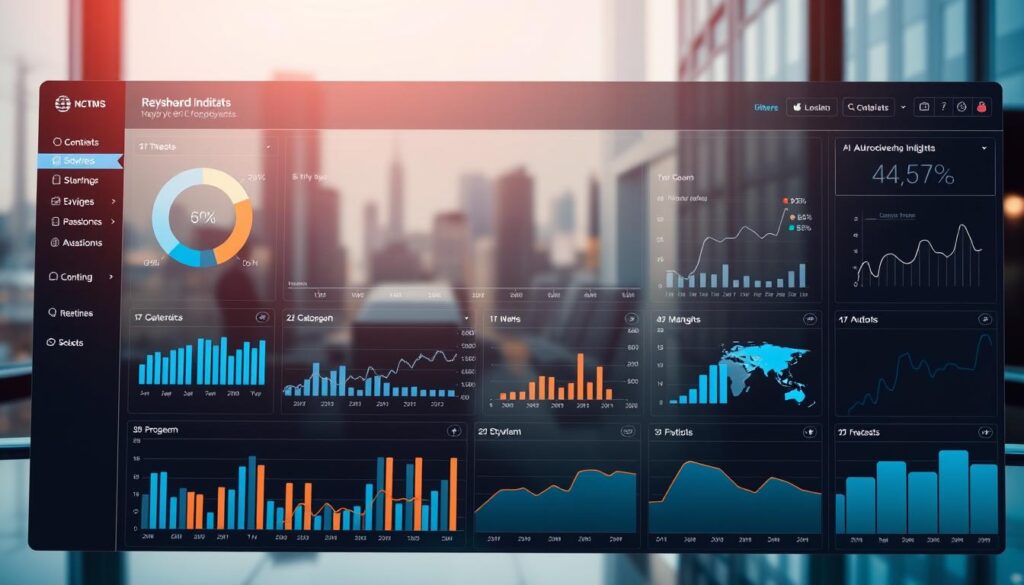
We centralize data so teams can track progress against targets in real time. Visual tiles show targets vs actuals, trend lines, and thresholds so owners see risk or opportunity at a glance.
Centralize data and visualize targets vs actuals
Start by standardizing definitions and formulas. When every report uses the same math, the organisation trusts the numbers and acts faster.
We add drill-downs from each performance tile to supporting charts. That helps users self-serve answers and reduces meeting time.
Balanced scorecard for strategy, operations, and customers
We design a balanced scorecard view that links finance, customers, internal processes, and learning. This balance avoids siloed indicators and aligns objectives across the team.
- Embed owner names and review dates on cards to reinforce accountability.
- Keep layouts clean, labels consistent, and colors meaningful to speed understanding.
- Enable sharing and permissions so the right people see the right kpis and collaborate safely.
“A dashboard should make performance visible, trusted, and easy to act on.”
Example layout: revenue growth, profit metrics, NPS, pipeline, and CSAT on page one, with department tabs and drill-downs by project and time.
Need a working prototype this month for your Malaysia team? Whatsapp us for more information at +6019-3156508.
Create a KPI-Driven Culture Across the Organization
Embedding performance measures into everyday work makes progress visible to everyone.
We raise data literacy so employees read, question, and use numbers in daily decisions. Training and simple dashboards turn abstract targets into clear actions.
We assign each team and employee a focused set of kpis and one kpi per owner where possible. This links day-to-day tasks to company goals and makes impact tangible.
- Set management rituals: weekly check-ins and monthly reviews to keep conversations constructive.
- Use BI platforms to show real-time performance and remove bottlenecks to access.
- Celebrate wins and learn from misses so indicators drive learning, not blame.
- Codify best practices for definitions, targets, and updates as teams scale.
“Open access and clear ownership boost accountability and engagement.”
We tie incentives and recognition to outcomes and connect frontline sales and service indicators to strategic results. Want help running a KPI kickoff workshop? Whatsapp us for more information at +6019-3156508.
Iterate and Improve: Reviewing, Refining, and Resetting KPIs
We treat measurement as a living process that adapts as data and customers change.
Regular check-ins to adjust to market and customer changes
We schedule short review cycles so teams can assess progress and decide next steps quickly.
Leading indicators need frequent checks; lagging measures validate long-term progress within the agreed timeframes. We monitor rate changes, seasonality, and one-off events before we reset targets.
- Review frequency aligns with decision cycles to avoid wasted time.
- Refine definitions, baselines, and targets as data quality improves.
- Retire stale kpis and add new ones deliberately to keep the set lean.
- Publish changes immediately so teams work from the latest truth.
| Measure type | Review cadence | Purpose |
|---|---|---|
| Leading indicators | Daily / Weekly | Learn fast and adjust tactics |
| Lagging indicators | Monthly / Quarterly | Validate progress toward objectives |
| Governance | Quarterly | Reset targets, document learnings |
“Keep reviews constructive and focused on the next best move, not blame.”
Need a quarterly KPI refresh template? Whatsapp us for more information at +6019-3156508.
kpi Best Practices for Malaysian Businesses Today
For Malaysian firms, picking indicators that match capacity is the difference between steady growth and costly churn.
Align KPIs to business goals, resources, and capacity
We start by matching each performance indicator to a clear business goal and the team that will act on it. Targets must reflect past data and local market realities.
- Balance ambition and capacity: don’t boost acquisition if service cannot sustain satisfaction.
- Set realistic profit margin and sales targets using historical performance and industry benchmarks in Malaysia.
- Include customer measures like CSAT and net promoter to protect relationship-driven growth.
- Make definitions clear: data sources, formulas, owners, and review cadence are non-negotiable.
“Align measures to decisions, not vanity — that keeps teams focused and customers happy.”
| 专注 | Example indicator | Review cadence |
|---|---|---|
| Sales & Marketing | New customers / conversion rate | Weekly |
| Operations | Service capacity / response rate | Daily / Weekly |
| 金融 | Profit margin | Monthly |
We upskill employees on data so insights translate into fast, confident action. Need localized KPI targets and dashboards? Whatsapp us for more information at +6019-3156508.
结论
Clear measures and simple rules for review turn data into daily decisions that move the business.
We recap the journey: define a key performance indicator versus a metric, pick the few kpi and kpis that matter, and set SMART targets to keep us on track.
Use leading and lagging indicators to track progress, assign owners, and run monthly management reviews so each project can act fast.
Dashboards, balanced scorecards, and simple playbooks help every team see objectives, use practical examples in sales and marketing, and access formulas and data immediately.
Culture makes measurement work—when every employee understands the numbers, satisfaction and success follow. Iterate, refine, and resist adding metrics that don’t change outcomes.
Turn this structure into action with our help — Whatsapp us for more information at +6019-3156508.
FAQ
What is a key performance indicator and why does it matter?
A key performance indicator is a measurable value that shows how well we’re meeting a specific business goal. It matters because it helps us focus on outcomes that drive growth, like revenue, customer satisfaction, or employee productivity, and guides decision-making across teams.
How do we tell the difference between a KPI and a regular business metric?
Not every metric is a key performance indicator. Metrics track activity or outputs, while KPIs connect directly to strategic objectives. We treat a measure as a KPI only when it impacts our goals and prompts action when performance changes.
What types of KPIs should we use—strategic, operational, or functional?
We use all three. Strategic indicators track long-term goals like market share and profit margin. Operational indicators monitor day-to-day process performance. Functional indicators focus on department outcomes—sales, marketing, finance, IT, and HR—to support the larger strategy.
What is the difference between leading and lagging indicators?
Leading indicators predict future performance, such as pipeline value or customer intent signals, while lagging indicators prove outcomes, like closed revenue or quarterly profit. We balance both to forecast and validate progress.
How should we develop KPIs that actually drive action?
Start by defining use cases and the data literacy needs of teams. Then write SMART measures that are specific, measurable, attainable, relevant, and time-bound. Keep the list short to avoid overload and ensure each KPI triggers clear decisions.
How do we set realistic KPI targets and assign ownership?
Use competitor benchmarks, past performance, and industry standards to set targets. Decide whether targets should scale progressively or remain steady. Assign a KPI owner who reviews performance on a regular cadence and is accountable for improvements.
Can you give examples of department-level KPIs we can start tracking?
Yes. For sales: new inbound leads, pipeline value, and average order value. For marketing: MQLs, SQLs, conversion rate, ROMI, and net promoter score. For finance: gross profit margin and operating expense ratio. For IT & service: time to resolution, reopened tickets, and customer satisfaction (CSAT).
What makes an effective KPI dashboard or scorecard?
An effective dashboard centralizes data, visualizes targets vs. actuals, and highlights trends and variances. A balanced scorecard combines strategic, operational, and customer views so teams see how their work contributes to organizational goals.
How do we create a KPI-driven culture across our organization?
We promote transparency by sharing results, teach teams how to interpret measures, and link performance to decision-making and incentives. Regular reviews and visible scorecards help everyone understand priorities and progress.
How often should we review and refine our KPIs?
We schedule regular check-ins—monthly or quarterly depending on cadence—to adjust KPIs for market shifts, customer behavior, and internal changes. Frequent reviews prevent stale targets and keep measures aligned with strategy.
What best practices should Malaysian businesses consider when choosing KPIs?
Align indicators to your business goals, available resources, and operational capacity. Use local market benchmarks where possible, focus on customer experience and acquisition costs, and ensure teams have the data tools and skills to act on insights.