
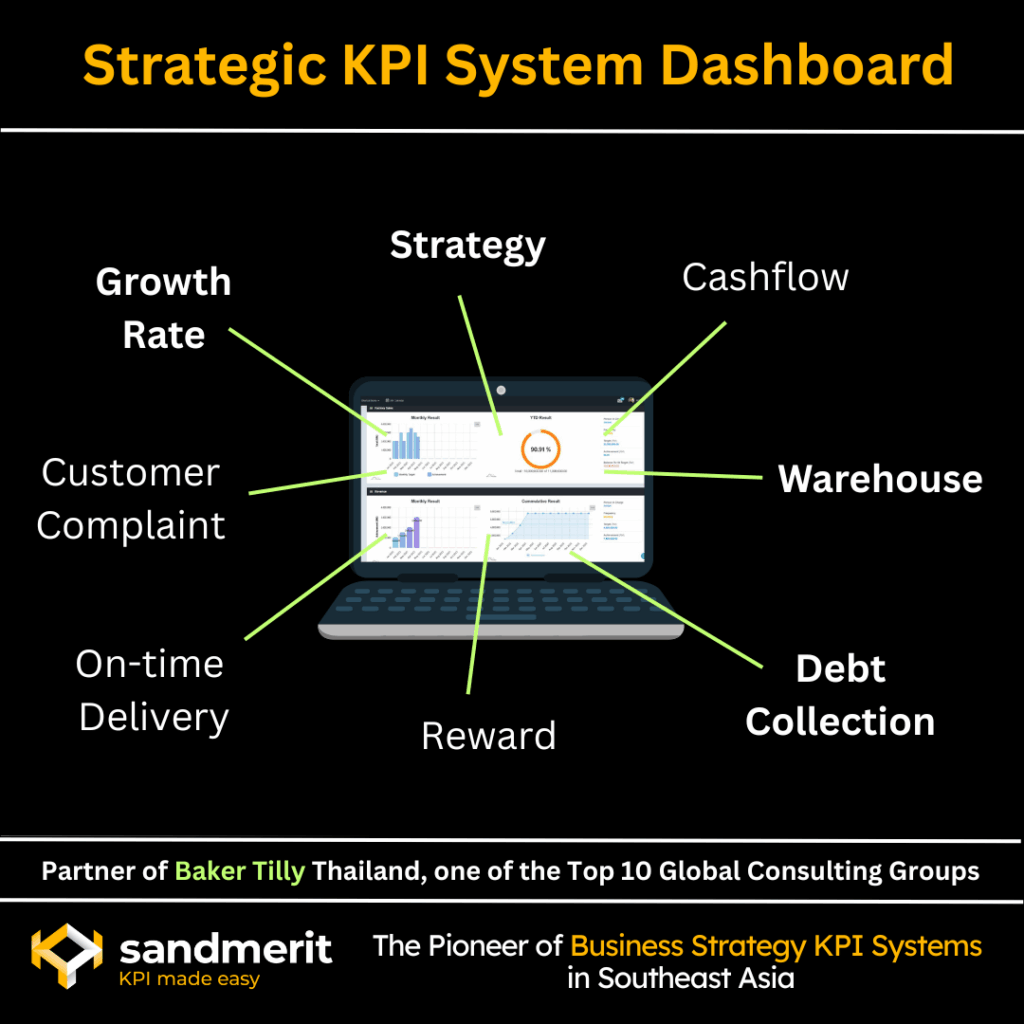
When business owners search for kpi reporting tools, most of them think they are looking for a “better dashboard” or a faster way to generate reports. They want cleaner charts, automated summaries, and less manual work from HR or department heads.
But after working with hundreds of companies across Malaysia and Southeast Asia, I can tell you something important:
Many businesses don’t actually have a KPI reporting problem.
They have a KPI execution problem.
They already have numbers.
They already have reports.
They already have monthly meetings.
Yet results stay the same.
That’s why the real purpose of kpi reporting tools is not to “look professional.” The purpose is to turn performance data into daily actions, stronger accountability, and measurable 生产率 improvement.
In this article, I’ll explain what KPI reporting tools should do, why many tools fail in real businesses, and how sandmerit KPI 123 helps companies build a complete KPI system that drives real outcomes—not just reports.
Why KPI Reporting Tools Matter More Than Ever
In today’s business environment, companies face constant pressure:
- higher labor cost
- slower productivity
- inconsistent employee performance
- higher customer expectations
- rising competition
- thinner profit margins
When profit is under pressure, leaders cannot rely on “gut feeling” anymore. They need data. They need clarity. They need alignment.
This is where kpi reporting tools become critical.
A KPI report is not just a document. It is a leadership tool.
It shows the company:
- what is working
- what is failing
- where resources are wasted
- which department needs support
- which team deserves reward
- which KPI needs adjustment
A business that uses KPI reporting correctly can react faster, improve faster, and grow faster.
The Big Mistake: KPI Reporting Without KPI Alignment
Many companies invest in KPI reporting tools but still fail to see improvement. Why?
Because the KPI framework is not aligned to business strategy.
This happens when KPIs are created based on job tasks, not business outcomes.
For example:
- A department tracks “number of reports submitted” but not “accuracy and impact of decisions.”
- A warehouse tracks “items processed” but not “picking errors and delivery efficiency.”
- A sales team tracks “calls made” but not “conversion rate and profit margin.”
So the report looks active, but the business does not move.
A KPI report is only meaningful when the KPI is meaningful.
That’s why the best kpi reporting tools must support strategic alignment, not just data collection.
What Great KPI Reporting Tools Must Deliver
A real KPI reporting system should give management four types of clarity.
1) Clarity of Direction
Employees should not be guessing what matters.
With proper KPI reporting, every staff member should know:
- what the company is trying to achieve
- what their department must deliver
- what they personally are responsible for
This creates focus.
When focus improves, 生产率 improves.
2) Clarity of Performance
Many companies struggle because performance is “invisible.”
Managers only notice problems when:
- customers complain
- projects are delayed
- mistakes become expensive
- staff resign
- profit drops
By then, it’s already too late.
Good KPI reporting tools provide visibility early, so managers can take action before issues become losses.
3) Clarity of Accountability
A KPI report must clearly show ownership.
If a KPI has no owner, it becomes “everyone’s job,” which means nobody’s job.
The best kpi reporting tools help managers answer:
- who is responsible
- who is improving
- who is struggling
- who needs coaching
- who deserves recognition
This creates a performance culture, not a blame culture.
4) Clarity of Reward and Fairness
A KPI report should lead to fair reward distribution.
If KPI reporting does not connect to reward, KPI becomes a “nice to have.”
Employees will treat it like paperwork.
But when KPI reporting is transparent and tied to rewards, employees become more engaged because they trust the system.
Why Many KPI Reporting Tools Fail in Real Companies
Most tools fail not because the software is bad, but because the implementation is incomplete.
Common reasons include:
KPI Becomes an HR Project Instead of a CEO Project
When KPI is driven only by HR, employees don’t take it seriously.
Real KPI success requires leadership commitment.
KPI Reporting Is Too Complicated
Some systems require too many forms, too many metrics, and too many manual updates.
Employees become tired. Managers stop checking. The system dies.
KPI Reporting Does Not Reflect Real Work
If KPIs are not designed based on business reality, employees will not believe the report is fair.
And once trust is lost, KPI adoption fails.
KPI Reporting Is Not Supported With Coaching
Even with a great tool, people still need guidance:
- how to interpret KPI results
- how to improve performance
- how to align daily actions with KPI targets
This is where most software-only providers cannot help.
sandmerit KPI 123: KPI Reporting Tools + Real Implementation Support
At sandmerit, we do not believe KPI reporting tools alone can solve performance problems.
That’s why we created sandmerit KPI 123, a complete solution that combines:
- consulting
- team alignment workshops
- and KPI system automation
This is the key difference between sandmerit and many other solution providers.
Most competitors fall into one of two categories:
- Software companies that sell KPI tools without consulting
- Training providers who teach KPI theory without a system
sandmerit is different because we deliver both.
We help companies design the KPI framework, align the team, and then automate the KPI reporting process so execution becomes easy.
The 3 Stages That Make sandmerit KPI Reporting Actually Work
Stage 1: CEO Coaching (Strategy and KPI Direction)
We start with the CEO because KPI must reflect business strategy.
In this stage, Wilson works closely with the leadership team to clarify:
- vision and direction
- business strategy
- corporate KPIs
- reward structure linked to performance
This ensures KPI reporting is not just reporting “activities,” but reporting real business progress.
Stage 2: KPI Workshop (Team Buy-In and Alignment)
Many KPI systems fail because employees resist KPI.
Not because employees hate KPI, but because they fear unfairness.
The sandmerit workshop is designed to build understanding and trust:
- why KPI matters
- how KPI scores work
- how reward is calculated
- how teamwork impacts results
- how to focus on the right outcomes
This is one reason sandmerit has received more than 600 testimonial videos, not only from CEOs, but also from managers and employees.
It proves that the sandmerit KPI 123 approach is accepted at every level, not just top management.
Stage 3: KPI System Automation (Reporting Becomes Simple)
Once KPI is aligned and accepted, KPI reporting becomes powerful.
The sandmerit system automates:
- KPI tracking
- KPI scoring
- KPI reporting dashboards
- performance review processes
- transparency for employees
Managers can monitor performance faster. Employees can track their own progress. HR can reduce paperwork.
That’s when KPI reporting tools truly become a business advantage.
Why Wilson’s Approach Produces Real Results
Many people talk about KPI. Few can implement KPI successfully across industries.
Wilson Ten is widely known as Malaysia’s KPI King because he has dedicated more than 23 years focusing on KPI implementation and performance management.
He has coached and implemented KPI systems for:
- SMEs
- multinational corporations
- public listed companies
Wilson is also the Chairman of the Professional Committee of International KPI Standards, working together with international advisors to raise KPI implementation standards across the region.
What makes Wilson’s approach different is simple:
It is hands-on, practical, and focused on execution—not theory.
sandmerit is not a training provider that gives lectures and disappears.
sandmerit is an implementation partner that stays with clients until KPI works.
Final Thought: KPI Reporting Tools Should Change Behavior, Not Just Create Reports
If you are searching for kpi reporting tools, don’t only look for dashboards.
Look for a system that can help you:
- align your KPI with strategy
- build employee trust
- improve execution
- drive Productivity
- and reward performance fairly
Because the goal of KPI reporting is not reporting.
The goal is results.
And when KPI reporting is implemented correctly, it becomes one of the most powerful management systems a company can have.
#kpi #kpireporting #kpireportingtools #kpisystem #performancemanagement #performancemanagementsystem #productivity #businessstrategy #leadership #management #sandmerit #KPIKing #wilsonten #ceo #hrtech #performance #employeeengagement #companyculture