
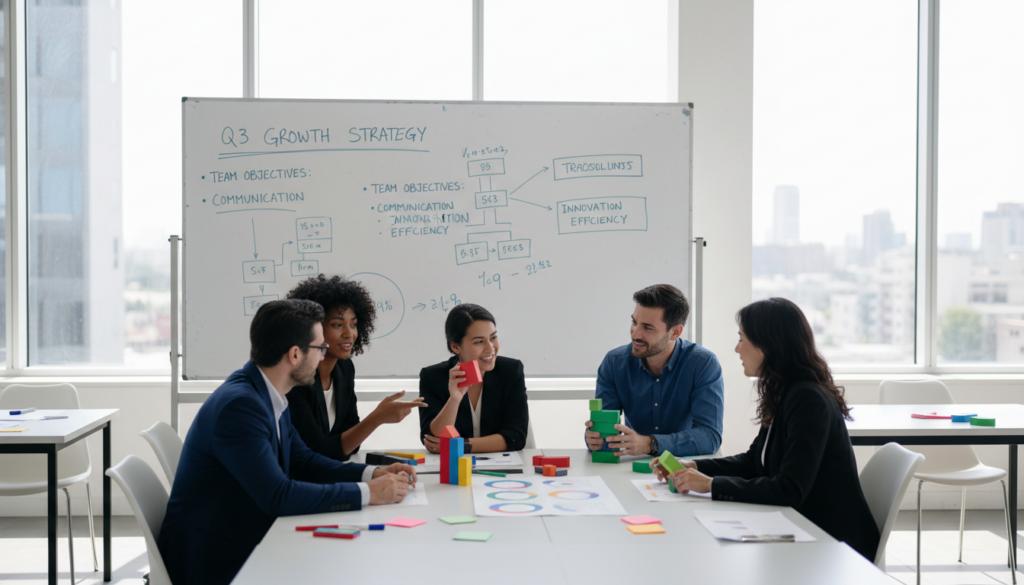
We present a practical, Malaysia-focused guide for corporate sessions that deliver measurable results. Our approach pairs familiar office formats with a KPI lens so leaders track real change.
We recommend the sandmerit KPI performance management system to map each activity to communication, collaboration, speed, accuracy, and decision quality. This lets HR, leads, and planners see which skills improve and by how much.
These weather-proof formats run well in meeting rooms, conference venues, and hotel ballrooms. Examples include escape-style puzzles, quick-win contests, creative builds, and scavenger challenges that measure outcomes, not just fun.
Contact us to tailor a program and set clear targets: Whatsapp us at +6019-3156508. We outline timing, ideal group sizes, space needs, scoring examples, and debrief prompts so you can deliver impact with confidence.
Key Takeaways
- KPI focus: Every activity links to clear performance metrics.
- Sandmerit KPI offers the tracking and reporting needed for measurable improvement.
- Indoor formats are reliable in Malaysia and fit many venue types.
- We provide recommended timing, sizes, and scoring templates.
- Contact via Whatsapp +6019-3156508 for tailored programs and scheduling.
Why Indoor Team Building Works for Malaysian Teams
For Malaysia’s climate and meeting schedules, indoor sessions are the practical way to guarantee outcomes. We plan activities that run “rain or shine” in offices, conference rooms, ballrooms, and breakout areas.
We design formats that suit different energy and personality types. Low-pressure creative rounds sit alongside higher-tempo challenges so every participant finds a role.
Weather‑proof engagement for offices, conference rooms, and event venues
Reliable logistics: indoor formats avoid cancellations from rain or heat and fit tight corporate timetables.
Inclusive options for different energy levels, personalities, and roles
We set rules so introverts, senior staff, and cross-functional groups can contribute meaningfully without awkward spotlight moments.
How activities strengthen communication, trust, and morale fast
Short feedback loops let groups communicate, try, and adapt within minutes. That accelerates learning and shows clear links to workplace behaviour.
| Benefit | How we deliver it | Typical venue |
|---|---|---|
| Consistent outcomes | Repeatable formats with clear scoring | Boardroom / ballroom |
| Inclusive participation | Role-based rules and low-pressure options | Conference room / breakout |
| Fast morale boost | Shared wins, recognition, and structured debriefs | Hotel event room |
How We Make Every Game KPI-Driven
Our method ties each exercise to clear metrics so leaders can track real behaviour change. We define “KPI-driven” by choosing activities that surface specific skills — handoffs, prioritisation, listening, and delegation — rather than picking what is trendy.
Common KPIs we map
Typical measures include response time, error rate, quality of handovers, participation balance, and decision alignment across team members. We also capture observation notes on how working together shifts under pressure.
Scoring models that measure results
Scoring blends points for speed and accuracy with teamwork indicators like role clarity, communication efficiency, and collaboration quality.
- Fairness rule: reward clear instructions and confirmation loops, not only loud contributions.
- Example rubric: time-to-complete, reworks count, penalties for rule breaks, and bonus points for documented strategy changes.
Debriefs that translate play into action
“We turn what happened into what we do on Monday.”
Debriefs convert observations into a short action plan: meeting norms, escalation rules, and ownership. Teams run a second round to compare metrics and see measurable progress within the same session.
How to Choose the Right Indoor Games for Your Group Size and Time
Match what you run to who’s in the room, how much time you have, and the space you can use.
Small groups vs large group formats: For small groups we keep roles balanced and give each player clear tasks. For a large group we split into stations and rotate so everyone participates.
Splitting groups for fairness
We mix departments, assign rotating captains, and aim for 4–6 players per side to keep engagement high.
Time planning
Options work from quick 10–15 minute icebreakers to 60-minute headline rounds and 2–3 hour circuits with rotations and a final. Short modules let us compare metrics at the end.
Space and supply needs
Room layout matters: place stations along one wall, set scoreboards at the side, and reserve a clear end area for briefings.
| Constraint | Recommended format | Supplies | Typical duration |
|---|---|---|---|
| Boardroom | Discussion + short relay | Chairs, paper | 30–60 minutes |
| Ballroom / large room | Rotating stations, finals | Props, scoreboards, pieces | 1–3 hours |
| Breakout room | Focused skill drills | Tape, paper, pens | 15–60 minutes |
We provide a flexible list of formats so planners in Malaysia can mix and match without overcomplicating logistics.
High-Impact Problem-Solving Games That Get Teams Working Together
We run structured problem-solving formats that push priorities, delegation, and quick alignment. These activities force groups to assign roles, share clues fast, and make evidence-based choices under pressure.
Escape room challenge for delegation and fast decision-making
Escape rooms run ~60 minutes and suit 6–10 players per room (up to ~30 total when parallel). We split puzzle streams and appoint leads so work is not duplicated. Success links to decision speed and first-try accuracy.
Murder mystery clue-solving for analytical thinking and teamwork
Murder mystery runs 2–3 hours and scales to ~50 participants. Teams collect clues, test assumptions, and assign roles like scribe and analyst. Timed reveals and checkpoint scoring keep large groups engaged.
Enigma puzzle-and-negotiation format for strategy and points
Enigma is 60–90 minutes for 20–100 people. Teams earn points for correct answers, then negotiate trades to improve scores. KPIs include role clarity, confirmation loops, and accuracy on first attempt.
“Award points for correct solutions, bonus for early completion, and penalties for guessing without evidence.”
Example: 10 points per correct lock, +5 for first-team finish, −3 for unverified guesses.
Trust and Communication Games That Reveal Real Team Dynamics
We run focused trust and communication activities that surface how groups really speak, listen, and behave under pressure. These short modules expose whether instructions are clear, who steps up to guide others, and how quickly coordination improves after a retry.
Minefield navigation for clear instructions and team trust
Why it matters: Minefield navigation shows if verbal commands are precise and if players trust the guide enough to move confidently.
High-level rules: One blindfolded player navigates a field of obstacles while teammates give only verbal directions. No touching, no leading by the hand.
Scoring: We record time to complete, number of mine touches, and indicators such as use of sequential commands and confirmation checks.
Human knot for collaboration under pressure without letting go
Human knot is a constraint-based activity with no supplies. Players form a knot by holding hands and then untangle without letting go.
We observe who facilitates, who listens, and the difference between chaotic shouting and calm coaching.
Timing: We timebox rounds to 10–20 minutes so groups can retry with improved strategies and compare metrics.
“Clear, calm instructions cut completion time and reduce mistakes. That change shows in Monday handovers.”
| Activity | Key metric | Typical duration | What we observe |
|---|---|---|---|
| Minefield Navigation | Completion time, mine touches, command quality | 30–90 minutes (module) | Instruction clarity, trust, role clarity |
| Human Knot | Completion success, time, number of breaks | 10–20 minutes per round | Collaboration style, patience, leadership emergence |
| Combined debrief | Behavioral actions to test back at work | 10–15 minutes | Handovers, psychological safety, coordinated response under pressure |
- Practical link: Outcomes map to real workplace behaviours — handovers, escalation, and speed under pressure.
- We use the results to set one short action for the next week: a clearer handover step or a facilitation cue.
Fast-Paced Competitive Games for Big Energy and Quick Wins
When you need a visible scoreboard and quick engagement, fast-paced contests deliver both.
Classic Minute to Win It
Timed micro-challenges run in minutes and lift energy fast. We run these for 1–2 hours, splitting a large group into small teams so every player rotates through short, sharp tasks.
Game show-style challenges
Family Feud-inspired formats push collaborative answer-finding and quick consensus. Turn-taking teaches decision quality under pressure while a public scoreboard keeps motivation high.
Quiz Masters trivia
Trivia rewards speed and accuracy. Smart strategy—when to lock in an answer or confer—often beats raw knowledge.
Task Master-style missions
Creative, constraint-driven tasks force adaptability and role swaps. These rounds spark laughter, boost creativity, and reveal problem-solving approaches.
- Why these formats work: fast engagement, visible points, and high participation.
- Fair play for a large group: rotate players, track participation balance, and reward teamwork behaviours.
- Finals: top teams qualify; side awards keep morale high.
| Format | Duration | KPI focus |
|---|---|---|
| Minute to Win It | 1–2 hours (modules in minutes) | Response time, accuracy, participation balance |
| Game show-style | 30–60 minutes rounds | Decision quality, consensus speed, teamwork |
| Quiz Masters | 20–45 minutes | Speed, accuracy, strategic play |
| Task Master-style | 30–60 minutes | Creativity, adaptability, role flexibility |
“Fast rounds reveal how groups perform under real pressure and translate into new habits at work.”
Creative Indoor Challenges That Turn Ideas Into Results
Creative challenges push groups to convert loose ideas into measurable outcomes in one focused session. We choose formats that lower barriers, invite quieter voices, and leave a tangible output everyone can point to.
Innovation challenge: design, build, pitch
We run a tight flow: brainstorm, pick an idea, prototype, and pitch—all on a strict timebox. Random materials force rapid problem solving and spark fresh ideas.
Scoring blends clarity of pitch, feasibility, process quality, and how well groups adapt when constraints change mid-session.
Group mural painting
Scaled for 5–500 people, mural painting is about shared ownership and communication. Success depends on alignment of style, consistent execution, and clear handoffs between subgroups.
Paint‑and‑sip and DIY craft workshops
Paint‑and‑sip sessions (1–1.5 hours) offer low-pressure bonding while we track participation and cross-department comfort. DIY craft workshops (2–3 hours) let teammates learn skills, trade tips, and leave with a keepsake.
Practical example: assign roles—designer, builder, presenter, timekeeper—to ensure everyone contributes and KPIs capture participation, idea quality, and delivery under time pressure.
“Creativity becomes measurable when teams produce an artifact, explain choices, and reflect on what changed.”
- Why this works: Creative activity lowers risk, surfaces new ideas, and produces evidence of collaboration.
- Outcomes map to communication, coordination, and how quickly ideas turn into working outputs.
Build-and-Prototype Games That Teach Planning and Iteration
Practical build sprints force teams to prototype early, fail fast, and improve in minutes. We use tight rounds so planning, testing, and quick learning become measurable skills.
Spaghetti-and-marshmallow tower
This rapid engineering challenge gives groups ~18 minutes to construct the tallest freestanding tower that must support a marshmallow on top.
What we measure: time management, role clarity, iteration count, and final stability. Height plus support stability defines the score.
Brick Masters-style timed builds
Surprise themes and limited pieces force quick division of work and consensus. Short rounds reward fast prototypes and visible iteration.
Scoring blends creativity, rework rate, and whether teams use feedback instead of blaming.
LEGO bridge build
Teams have ~20 minutes to span a “river” using standardized kits. Success depends on shared goals, structural choices, and aligned decisions.
We run parallel stations for large groups and use a uniform judging rubric so scoring stays fair across all players.
“Early prototypes beat perfect plans; iteration is the most teachable skill in a short session.”
| Format | Duration | Key KPIs |
|---|---|---|
| Spaghetti tower | ~18 minutes | Height, stability, iteration count |
| Brick Masters | 15–25 minutes | Rework rate, communication, creative use of pieces |
| LEGO bridge | ~20 minutes | Structural integrity, shared planning, role clarity |
How we scale: parallel build stations, matched kits, and consistent judges let us run this format for many groups at once. That keeps logistics simple and results comparable across the room.
Scavenger Hunt and Riddle Games for Clues, Speed, and Collaboration
Scavenger hunts turn familiar spaces into timed puzzles that test speed, collaboration, and clue-solving skills. We design each module to reward clear roles, quick decisions, and concise communication.
Why this format works: These activities blend rapid clue-solving with movement and shared tasks. That mix keeps energy high while producing measurable behaviours you can track after the session.
Office scavenger hunt with riddles
In an office scavenger hunt, small teams solve riddles, locate hidden clues, and finish mini-challenges for points. Typical runs last 60–90 minutes and suit groups up to ~30 people.
An example clue leads players to common spots like the pantry, meeting room, or reception desk. Riddles encourage observation, quick verification, and confirmation loops.
Museum-style scavenger hunt for larger groups
For a premium option we run a museum-style scavenger hunt. This format runs ~90–120 minutes and scales from 15 to 1,000 participants with guided hosting.
It layers puzzles, trivia, and exhibit-based challenges so groups learn while they race. A host manages flow, reveals controlled clues, and keeps the experience fair.
- Fairness controls: staggered starts, timed clue release, and penalties for skipping steps.
- KPI links: how teams divide search zones, share findings, and avoid duplicate work.
- Outcome: measurable improvements in coordination, communication, and speed under pressure.
“Clue-driven runs show who coordinates, who confirms, and how quickly a group turns information into action.”
Movement-Based Indoor Games to Boost Focus and Team Energy
Quick movement modules reset focus and lift energy without athletic skill or outdoor space. We run short rounds that deliver measurable shifts in attention, process flow, and communication.
Pipeline marble or golf-ball transport
Teams use PVC pipes to move a marble or golf ball from start to finish. Give about 5 minutes to plan, then run timed attempts so improvement is clear.
We treat this as a process-flow simulation: clean handoffs, steady pacing, and minimal drops score higher.
Wall or floor tic-tac-toe relay
Mark a grid on the wall or floor with tape. Players sprint in turns, place a marker, and later move pieces to form a line.
This activity forces a balance of speed and strategy while showing who verifies moves and who rushes.
Walk-and-stop listening drill
A leader calls commands while players walk. Mid-run, we flip meanings to test listening and adaptability.
We measure error rate, recovery speed, and clarity of communication when tempo increases.
- Delivery: 5 minutes planning, timed runs, repeat for measurable gains.
- Safety: clear lanes, non-slip tape, and room at each side to avoid collisions.
“Short, active rounds reveal process gaps fast and boost collective focus.”
Indoor Social Bonding Games That Break Down Barriers
A well-structured social evening turns casual fun into measurable connection across departments. When planned with purpose, these sessions build confidence, inclusion, and empathy in a way that helps daily collaboration.
Karaoke team night for confidence and cross-team connection
Duration: 1–2 hours; up to ~30 people.
We run karaoke as a confidence builder where teammates support one another and flatten hierarchy. This activity reduces tension and opens new lines of informal communication between departments.
Cultural diversity celebration for inclusion, sharing, and unity
Duration: 2–3 hours; any size.
In Malaysia, shared food, music, and stories are powerful. We design segments so members present short cultural showcases. That creates respect, curiosity, and clearer communication across backgrounds.
Talent show format for recognition and morale
Duration: ~2 hours; up to ~50 participants.
Talent shows highlight non-work skills and increase empathy. People often leave with renewed respect for colleagues and a stronger sense of belonging.
- Not fluff: structured social formats strengthen morale and cross-team familiarity that improve work outcomes.
- Light scoring: optional awards like “most improved” or “best teamwork” keep focus on psychological safety, not competition.
- Pacing: plan 1–3 hours, keep segments tight, and rotate performers so engagement stays high.
- Suitability: ideal when groups include mixed seniority or when connection is the primary goal.
“Showcasing who people are beyond roles builds the small, everyday trust that changes how we hand work across the room.”
Skill-Building Indoor Activities for Leadership, Strategy, and Decision-Making
These activities put strategy into practice so participants learn to lead, decide, and adjust under pressure. We design each activity as fun with a purpose, focusing on leadership, prioritisation, and measurable skills transfer.
Business simulation game for real-world thinking and role clarity
Our business simulation runs ~2 hours and scales to any size via small groups. Teams manage budgets, operations, and priorities to see the consequences of choices fast.
Cook-off competition for time, delegation, and leadership moments
A cook-off (2–3 hours; ~5–50 participants) pressures teams to assign roles, sequence tasks, and hit quality targets under a strict deadline. We record who directs, who supports, and who keeps the group calm.
Hands-on cooking class for cooperation and communication
The hands-on class (2–3 hours; up to ~30) rewards clear communication and timely handoffs. Success depends on timing and on helping others without overstepping responsibilities.
How we evaluate leadership moments: we score direction-setting, execution support, calm under change, and adaptive decisions. Most sessions run 2–3 hours with clear stations and uniform judging so comparisons are fair.
Outcome: teams leave with practical improvements in planning, prioritisation, and how they work together when constraints are real. For more format ideas, see team-building activities.
How We Run a Smooth Indoor Team Building Session End-to-End
A clear operational plan turns a lively session into measurable workplace change. We follow a tight checklist so every minute counts and every player understands their role.
Pre-event checklist: materials, safety rules, and room setup
We confirm goals, agenda, group size, and the venue layout. Then we prepare a materials list, contingency plan, and safety brief.
Room standards: clear zones for stations, safe movement lanes, visible scoring, and a briefing area where everyone can hear.
During the activity: facilitation, points, and fair play
Our facilitators manage time tightly, explain rules plainly, and track points openly so scoring stays trusted. We enforce fair play and offer alternatives for varied physical needs.
Keeping momentum: short transitions, clear calls, and a steady rhythm across the sequence of play.
Post-game debrief: what worked, what didn’t, and next actions
Debriefs follow a simple script: observations, lessons, and concrete next actions. An example output: 3 behavior commitments, 2 meeting norms, and 1 communication habit to trial for two weeks.
“The difference between fun and impact is the discipline of setup, facilitation, and debrief.”
Book KPI-Driven Indoor Team Building in Malaysia
Schedule a results-driven session designed to sharpen communication, trust, leadership, or collaboration under pressure. We tailor each programme so the activity mix, scoring, and intensity match your culture and goals.
Tell us your goals, group size, time, and venue details
Please share: your primary goals, number of participants, available time, and room type (layout, seating, restrictions). These details let us propose a clear run-of-show and fair scoring model.
Whatsapp us at +6019-3156508
What we provide:
- A curated list of formats from our catalogue, adjusted to your objectives and culture.
- Facilitation, materials planning, safety checks, and visible scoring during the session.
- A structured debrief that converts observations into practical next actions for the workplace.
Why choose this approach: indoor sessions across Malaysia are flexible and reliable, so scheduling is easier and outcomes are repeatable.
| Request | Why we need it | What you get |
|---|---|---|
| Goals | Aligns KPI focus (communication, trust, leadership) | Tailored activity list and scoring |
| Group size & time | Determines format and pacing | Run-of-show and rotation plan |
| Room details | Confirms logistics and safety | Materials list and setup map |
“Clear inputs make clear outputs — tell us what you need, and we’ll deliver measurable results.”
结论
结论
A concise summary links choices made during play to real workplace habits and quick wins. The best indoor format matches your goals, fits your available time, and includes clear KPIs so progress is measurable.
We covered problem‑solving, trust and communication, quick competitive rounds, creative work, building and prototyping, scavenger hunts, movement drills, social bonding, and leadership skill sessions. The real value is structured scoring plus a tight debrief that turns observed behavior into a short action plan.
Even formats often seen with kids use the same mechanics—time pressure, constraints, iteration, and roles—and work very well for adult teams when facilitated professionally. Pick one or two activities now, prove impact in minutes, then scale.
Ready to tailor a KPI-driven plan in Malaysia? Whatsapp us at +6019-3156508 for a clear run‑of‑show and scoring model.
FAQ
What types of KPI-driven indoor team building games do we offer?
We offer a wide range of activities that map directly to measurable objectives. Examples include problem-solving challenges like escape-room scenarios and spaghetti-and-marshmallow prototype builds for planning and iteration, quiz-style trivia for speed and accuracy, scavenger hunts for clues and collaboration, and creative sessions such as group mural painting or DIY craft workshops to encourage creativity and shared ownership. Each activity includes scoring models and debriefs so we can track improvement in areas like communication, decision-making, and collaboration.
Why are indoor sessions a good fit for Malaysian offices and event venues?
Indoor options are weather-proof, making them ideal for conference rooms, ballrooms, or breakout areas in Kuala Lumpur, Penang, and beyond. They also allow us to include everyone regardless of energy level or role, from fast-paced Minute-to-Win-It rounds to low-pressure paint-and-sip sessions. This inclusivity boosts morale and ensures consistent results no matter the climate or location.
How do we align each game with specific KPIs?
We start by identifying the KPIs you want to improve—such as speed, accuracy, collaboration, or leadership. We then select or adapt activities with clear scoring models and observable behaviors that correspond to those metrics. Finally, we lead structured debriefs that translate in-game actions into workplace behaviors and actionable next steps.
How do we measure teamwork and performance during a session?
We use a combination of objective scoring (points for completed tasks, time-to-complete, accuracy rates) and facilitator observations (communication quality, role distribution, problem-solving approach). These inputs produce simple KPI reports that show strengths, gaps, and progress over time.
How do we choose the right format for small groups versus large groups?
For small groups we emphasize deep collaboration and role clarity with activities like business simulations or LEGO-style Brick Masters. For large groups we scale into multiple simultaneous challenges—scavenger hunts, quiz rounds, or game-show formats—splitting participants into balanced squads so every member contributes and we can still measure outcomes reliably.
What is the typical time planning for sessions?
We design programs from quick 15–30 minute energizers up to half-day or full-day workshops. Short sessions focus on rapid coordination and quick wins; longer formats allow for planning, iteration, and in-depth debriefs. We always match duration to your goals and available time.
How much space do we need for different activities?
Space needs vary: boardroom-style quizzes and strategy games require minimal room; relay or movement-based formats like pipeline marble transport need clear floor area; build-and-prototype challenges and mural painting work best in larger breakout zones or ballrooms. We provide space planning guidance for rooms, boardrooms, or event halls.
Can you tailor games for leadership development and decision-making?
Yes. We run business simulation games, cook-off competitions, and hands-on classes that require delegation, time management, and clear role assignments. These activities create measurable leadership moments and provide immediate feedback you can use in follow-up coaching.
How do you handle facilitation, safety, and fair play during events?
Our facilitators follow a pre-event checklist covering materials, safety rules, and room setup. During play we manage points, ensure fair play, and intervene to keep energy high and inclusive. After the session we run a focused debrief to capture learnings and next actions.
How do scavenger hunts and riddle formats work for corporate groups?
We adapt scavenger hunts to office layouts, museums, or conference venues, using riddles and clue chains that encourage collaboration and speed. For large groups we split participants into mixed-ability squads to balance skills and boost cross-team communication while keeping the experience competitive and fun.
What activities work best to boost morale and social bonding?
Low-pressure social formats such as karaoke nights, talent shows, cultural diversity celebrations, and paint-and-sip sessions create safe spaces for people to relax and connect. These formats help break down silos and improve interpersonal communication over time.
How do you ensure creativity and iteration in prototype challenges?
We use timed design-build-pitch formats like the innovation challenge and spaghetti-and-marshmallow towers. Teams plan, prototype, test, and iterate under constraints, which reinforces rapid learning cycles, resourcefulness, and clear communication—then we score outcomes and run a short retro.
Can we combine competitive and collaborative elements in one program?
Absolutely. Many clients request mixed formats—competitive quiz rounds or Minute-to-Win-It sprints alongside cooperative problem-solving and debriefs. This combination drives energy and creates teachable moments about cooperation under pressure.
What information do you need to book a KPI-driven session in Malaysia?
Tell us your objectives, group size, available time, venue type (room, ballroom, conference center), and any accessibility needs. You can WhatsApp us at +6019-3156508 to start planning. We’ll propose formats, a scoring approach, and a quote tailored to your goals.