
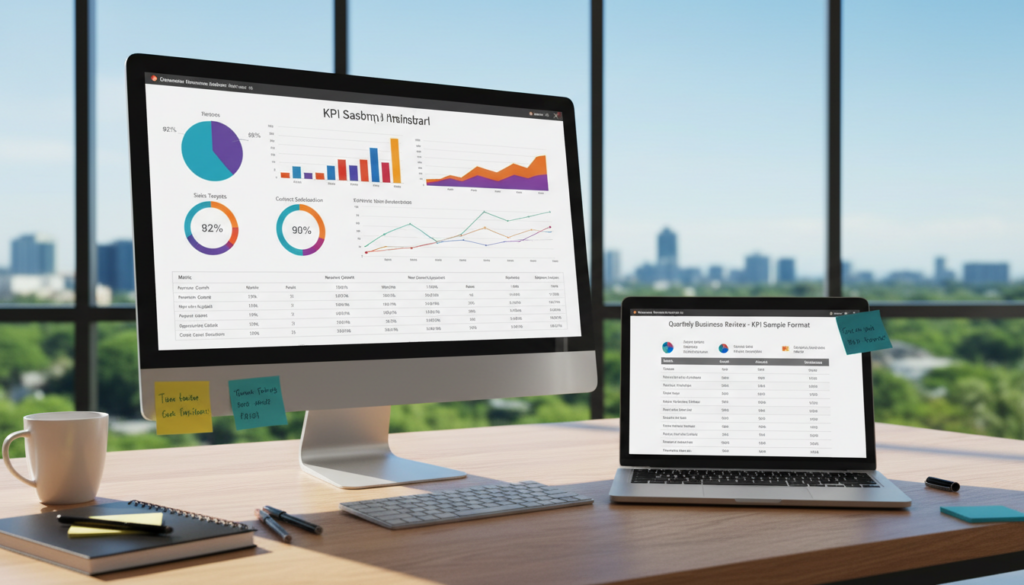
Surprising fact: we find that teams using clear performance indicators reduce decision time by over 40% across projects in Malaysia.
We define a KPI as a measurable value that shows how well an organization meets its key business goals. In this guide, we explain what Malaysians usually mean when they search for a kpi sample format and what a usable KPI statement must include.
We will set expectations for the full guide: definitions, KPI vs metrics, writing strong statements, and ready-to-copy templates for teams and managers. We treat tracking as a practical habit, not a reporting exercise, and we show how simple formats cut confusion and speed decisions.
We preview industry examples for marketing, sales, operations, and HR and use first-principles: measure, target, data source, frequency, and owner. For focus, we recommend keeping to 5–7 key indicators to protect execution and clarity.
For a deeper walkthrough on writing effective indicators, see our linked resource on how to write KPIs.
Key Takeaways
- We define KPIs as measurable values tied to business goals.
- Keep the dashboard tight: focus on 5–7 indicators for clarity.
- Every KPI needs measure, target, source, frequency, and owner.
- Good formats shorten meetings and speed decision-making.
- Templates will cover marketing, sales, operations, and HR.
What a KPI Is and Why It Matters for Business Goals in Malaysia
A KPI is a clear, measurable sign that tells us if our actions move the company toward its main objectives.
KPI definition: measurable value tied to key business objectives
Key performance indicators are specific numbers that show how effectively an organization is reaching its targets. We use them to evaluate success and to decide where to invest time or resources.
How KPIs connect strategy, goals, and outcomes across the organization
KPIs create a direct line of sight: strategic objective → KPI → target → actions. This makes gaps visible so leaders can fix problems fast.
- They align teams across branches and channels, which is vital for Malaysian businesses with mixed online/offline models.
- We use KPIs to build a shared language for weekly check-ins and management reviews.
- Different departments pick different indicators, but everyone measures success in a consistent way.
KPIs vs. Business Metrics and Other Performance Indicators
Not every number on a dashboard deserves the same label; some metrics guide strategy, others only inform. We draw a clear boundary between broad business metrics and the few measures that truly track strategic success.
Why every KPI is a metric, but not every metric is a KPI
All KPIs are metrics because they are quantifiable. But a KPI must also tie to a strategic goal and trigger a decision when it moves.
Many metrics are diagnostic. They help with troubleshooting but do not change management choices. If a measure does not influence action, it is not a key performance measure.
Examples of “nice-to-track” indicators that aren’t truly key
We often see teams track averages that hide outcomes. HR metrics such as average tenure, average salary, or HR-to-FTE ratio give context but may not show effectiveness by themselves.
Other indicators, like time on site without conversion context, are informative but not strategic. Tracking too many kpis dilutes accountability and makes reviews noisy.
- Rule: if it doesn’t change a decision, it’s probably not a KPI.
- Keep the dashboard tight so management can act fast.
The Anatomy of a Strong KPI Statement
A strong performance statement makes causal links visible: it shows what we measure, why it matters, and who owns the outcome.
Measure: choosing an expressive metric that tells a performance story
Measure should be a clear metric that describes quality and trend, not just a raw count. We pick metrics that reveal cause and effect so the team can act.
Target: setting numeric targets aligned to goal and time period
Targets must match the time window—monthly, quarterly, or annual—and reflect realistic improvement. Clear targets stop debates and guide execution.
Data source: defining where the data comes from to avoid gray areas
We record the exact system or tool for each measure (CRM, ERP, survey). Explicit data definitions remove disputes and boost trust in reporting.
Reporting frequency: monthly as a baseline, more often when needed
Monthly is our baseline for steady indicators. For fast pipelines we report weekly; for volatile or customer-facing metrics we monitor in real-time.
Owner: assigning accountability for tracking, reporting, and improvement
Every statement names an owner responsible for tracking, reporting, and driving improvement. Without an owner, data sits idle.
“Missing one element creates confusion in reporting; all five keep management focused and responsive.”
Mini example: Increase paid-conversion rate to 4.5% by end of Q2 (measure: paid conversions/visitors; target: 4.5% monthly; data: GA + CRM; reporting: weekly; owner: Growth Lead).
kpi sample format: Templates We Use for Clear KPI Tracking
Here are three ready-made templates that make progress visible and simple to use. Each template suits a different maturity level so teams and management get the view they need.
Simple template for fast team adoption
What it includes: measure, target, data source, frequency, owner. This sheet is built for weekly check-ins and spreadsheet use.
Why it works: Teams start reporting quickly and keep tracking in the same place.
SMART template for management reporting
What it includes: Specific goal, Measurable indicator, Attainable baseline, Relevant link to business goals, Time-bound deadline.
This version supports performance reviews and leadership reporting with clear relevance and deadlines.
Dashboard-ready template for real-time tools
What it includes: KPI name, definition, formula, target, thresholds, owner, refresh cadence. It maps directly to BI tools for enterprise visibility.
- We keep definitions consistent so terms like “conversion rate” mean the same across departments.
- Record current score, target score, and progress trend so the indicator stays actionable.
- Tips to boost adoption: keep templates short, automate data pulls where possible, and review them on a set cadence.
“Simple templates and clear ownership cut meeting time and improve progress visibility.”
How We Choose the Right KPIs Without Tracking Too Many
Start with outcomes, then pick the handful of measures that directly prove progress.
Why fewer indicators work: tracking too many kpis makes meetings reporting-heavy, blunts decisions, and scatters resources. We recommend keeping to 5–7 measures so teams stay focused and management can act quickly.
We shortlist indicators from strategy and business goals. First, define the outcome. Next, list candidate metrics that map to that outcome. Then test each metric for alignment and actionability.
Validate feasibility: confirm the data exists, can be collected reliably, and won’t demand excessive manual work. If data is hard to get, the measure will fail in practice despite high perceived value.
- Define outcomes → list candidates → test for alignment/action → select 5–7 kpis → assign owners.
- Balance a leading measure (to steer behavior) with a lagging measure (to confirm results).
Keep KPIs alive: review them when channels, capacity, or markets change so indicators stay accurate and actionable.
“A small set of well-chosen indicators speeds decisions and shows real progress.”
SMART Criteria for Better Key Performance Indicators
SMART criteria give us a practical checklist to turn business aims into working metrics. We use it to remove ambiguity and make progress easier to track.
Specific and measurable
Specific means the metric names what success looks like. We avoid vague goals such as “increase awareness.” Instead we write, for example, “increase website traffic by 15%.”
Measurable requires a clear formula and data source so teams stop debating numbers and start acting.
Attainable and relevant
Attainable ties targets to historical performance and current capacity. We test feasibility so targets motivate rather than demoralize.
Relevant ensures the indicator links to business goals. If a metric doesn’t move the company forward, we drop it.
Time-bound
Every goal has a time window. We match the reporting cadence to the work cycle: monthly for operations, quarterly for sales, annual for strategy.
Example: internal promotion rate — Track promotions per 100 employees monthly, set an attainable target, and review progress each quarter to confirm long-term success.
“SMART makes metrics that teams can own, measure, and improve.”
Leading vs. Lagging KPIs for Real Business Performance
We use two types of indicators to run reliable scorecards. Leading indicators act as early signals that predict future performance. Lagging indicators confirm outcomes after the work is done.
Leading indicators: early signals that predict future results
Leading indicators are forward-looking. Examples include pipeline value, lead conversion rate movement, or response time trends. These signals help us spot issues before they impact revenue.
Lagging indicators: outcome measures that confirm past performance
Lagging indicators measure results after the fact. Quarterly revenue or completed certifications show whether our actions delivered the intended value.
How to pair leading and lagging KPIs in one scorecard
Pairing gives us a holistic view. We track one outcome KPI (lagging), one driver KPI (leading), and add a quality/control measure when needed. For example, pair pipeline value (lead) with closed revenue (lagging) and win-rate quality.
In HR, we pair time-to-proficiency (leading) with qualification completion percentage (lagging). This combination helps teams predict progress and confirm impact.
“Combine predictors and outcomes on the same scorecard so teams can both act early and validate results.”
KPI Best Practices That Keep Performance Indicators “Alive”
We keep metrics useful by making sure each one leads to a decision or action. Living performance indicators must connect to strategy and to a clear business outcome.
Aligned: Every measure maps to a strategic goal and names an owner. If it does not, we remove it from tracking.
Accurate and consistent
Accurate means data integrity and a shared definition. We standardize names and formulas so departments report the same number.
Actionable
We design measures the team can influence with known levers. That keeps performance tied to daily work and faster improvement.
Drillable, simple, adaptable
Leaders see one headline figure; analysts can drill into segments. We review indicators on a set cadence and update them when resources or priorities shift.
| Best Practice | Purpose | Who | 成果 |
|---|---|---|---|
| Aligned | Link to strategy and business outcome | Owner (named) | Clear decisions |
| Accurate | Consistent data and definitions | Data owner | Trusted reports |
| Actionable & Simple | Controllable levers, single headline | Team lead | Faster improvement |
| Adaptable & Drillable | Review cadence and segment analysis | Management + analyst | Relevant tracking |
“Better practices turn numbers into questions that trigger timely action.”
Setting Targets, Thresholds, and Stretch Goals Without Demotivating Teams
Realistic goal-setting starts with a baseline and an honest read of what our team can achieve. We use historical data and present capacity to create targets that drive steady progress. A clear primary goal keeps work focused while a secondary stretch goal encourages extra effort.
Using historical data and current capability to set realistic targets
We set targets from baselines (past performance) and the limits of current staffing, budget, and tools. Percent-change targets and rate-based measures — for example conversion rate or churn rate — work well when definitions are fixed and data is reliable.
Creating thresholds (red/amber/green) to support faster decisions
Thresholds turn a number into action. We mark green for on-track, amber for caution, and red for immediate fixes. This helps management and the team act in time without waiting for month-end reviews.
- How we set targets: baseline + constraints = realistic point of departure.
- Use percent or rate targets carefully to avoid measurement confusion.
- Apply red/amber/green thresholds so teams decide faster and cut meeting time.
- Stretch goals are optional tiers that reward extra effort while keeping the main target achievable.
- Poorly set targets can invite gaming, hurt morale, and raise hidden cost.
“Keep targets clear, measurable, and tied to real capacity so the whole team feels able to reach them.”
Data, Reporting Cadence, and Governance for KPI Management
Consistent data practices and a pragmatic reporting cadence turn numbers into decisions for the whole organization. We set clear governance so each measure has an owner, a defined source, and a single calculation method.
Monthly, weekly, or real-time monitoring based on volatility
How we choose cadence: weekly for pipeline and service-level work, monthly for strategic metrics, and real-time for customer-facing measures that change fast.
We match reporting frequency to volatility so teams see meaningful movement without drowning in updates.
Standardizing definitions so departments report the same way
One definition, one number: we record the formula, data fields, and tool for every indicator. This prevents two versions of the truth when results roll up to leadership dashboards.
For multi-branch organizations in Malaysia, central definitions and governed dashboards save time and reduce reconciliation work.
Using review sessions to analyze progress and remove blockers
Our review agenda is short: score vs target, trend, drivers, blockers, and next actions with an assigned owner. This keeps the meeting focused on decisions, not explanations.
Governance is the practical rule set that keeps reporting consistent: ownership, source, and calculation. Good governance reduces meeting time and accelerates progress.
“Governance turns reporting into a tool for action, not a monthly ritual.”
Dashboards and Reporting Tools for KPI Tracking and Visibility
Interactive tools turn raw data into clear signals that teams can act on in minutes. We build views for enterprise roll-ups, department panels, and team drill-downs so everyone sees the same performance story.
When real-time reporting matters
Real-time reporting is essential for customer experience, sales pipeline movement, and service tickets. Fast refreshes let us fix issues before they affect outcomes.
What each view should show
Keep visuals simple: current score, trend over time, target line, and variance from target. These four elements make gaps obvious at a glance.
- Executive roll-up: headline scores and trend lines for strategy decisions.
- Department view: focused metrics for marketing, sales, ops, and HR with drill-down links.
- Team panel: live queue and task-level views for frontline service and sales work.
| View | Primary audience | Refresh cadence | Key visual |
|---|---|---|---|
| Executive roll-up | Leadership | Daily | Score & trend |
| Department panel | Managers | Hourly | Target vs score |
| Team drill-down | Frontline | Real-time | Live queue & variance |
“Limit widgets to measures that trigger decisions; add drill-downs for analysis.”
Data ownership and refresh rules keep reporting trusted. We assign an owner, set refresh windows, and archive old views so the tool stays useful, not noisy.
Marketing KPI Examples and Sample Formats
For fast decisions, we track a short set of marketing measures that link spend to outcomes.
Cost-efficiency KPIs show which campaigns earn profit and which drain budget.
- ROMI: revenue / campaign cost. Use to compare channel profitability.
- CAC: total cost to acquire a new customer. Set monthly targets by channel.
- CPL & CPA: cost per lead and cost per acquisition. Use for paid and lifecycle campaigns.
Growth tracking focuses on movement and source.
- Conversion rate — visitors to customers; pair with qualified lead counts.
- CTR — ad engagement that feeds top-of-funnel volume.
- Website traffic by source — shows dependable channels versus one-off spikes.
Customer value signals include Net Promoter Score and social engagement rate.
- NPS tracks loyalty and acts as an outcome confirmation.
- Engagement rate measures active interest and can be a leading indicator for retention.
Quick copyable KPI statement (measure, target, data source, frequency, owner):
- Example: Reduce CAC to RM150 by Q3 (measure: CAC; target: RM150; data: CRM + ad spend; frequency: monthly; owner: Growth Lead).
“Pair activity measures like clicks with outcome metrics such as qualified leads or revenue to avoid vanity reporting.”
Sales KPI Examples That Tie Directly to Revenue and Growth Rate
Strong sales measures connect daily activity to real revenue outcomes and keep forecasts honest. We list the practical indicators we use to run pipelines, coach reps, and support leadership decisions.
Sales revenue, growth, and average deal size for performance
Sales revenue is our primary lagging measure. Track monthly and quarterly totals, with a clear target and owner.
Average deal size helps set quota and staffing. Pair it with growth rate targets to show pace.
Lead conversion, pipeline value, and win rate for forecasting
We use lead conversion rate, pipeline value, and win rate as leading signals. These figures predict future revenue and guide resource allocation.
Cycle length, retention, and churn for long-term success
Average sales cycle length reveals capacity and cash timing. Monitor customer retention and churn to protect lifetime value and coordinate sales with customer success.
“Strong, quotes.”
| Metric | Use | Cadence |
|---|---|---|
| Sales revenue | Leadership score | Monthly |
| Pipeline value | Forecasting | Weekly |
| Lead conversion rate | Rep coaching | Weekly |
Operations KPI Examples for Quality, Time, and Cost Control
Operations measures translate daily work into clear signals that control cost, quality, and delivery time.
We list practical indicators that logistics, manufacturing, and service teams can use to improve performance. Each measure ties to decisions and an owner so the team acts fast.
On-time delivery, cycle time, and throughput rate to improve service
On-time delivery (OTD) tracks orders delivered by the promised date and improves customer service. Report weekly for volatile dispatch work and monthly for stable lanes.
Cycle time measures the time to complete a unit or process. Shorter cycle time lowers cost and speeds response.
Throughput rate shows units completed per hour or shift. Use it to size resources and spot bottlenecks quickly.
Inventory turnover, days in inventory, and order picking accuracy
Inventory turnover and days in inventory affect cash flow and service levels. Higher turnover frees working capital; longer days raise holding cost.
Order picking accuracy reduces rework and customer returns. Track accuracy rate per shift and assign a process owner in operations.
OEE, FPY, downtime, and waste reduction rate for continuous improvement
OEE combines availability, performance, and quality into one performance score. It shows where to target maintenance or process changes.
FPY (first-pass yield) measures the percent produced correctly the first time. Improving FPY cuts rework cost and speeds delivery.
Monitor production downtime and waste reduction rate to support continuous improvement programs. Assign ownership across production, maintenance, and operations management so fixes stick.
| KPI | Purpose | Cadence |
|---|---|---|
| On-time delivery | Customer service & delivery | Weekly |
| Inventory turnover | Cash flow & availability | Monthly |
| OEE | Overall performance & improvement | Daily/Shift |
| Order picking accuracy | Quality & rework reduction | Daily |
“Focus on a short set of meaningful measures so teams can act on time and cut cost without losing quality.”
HR KPIs That Support Organization Goals and Employee Performance
Good HR indicators translate staff experience into actionable signals for management. We view strategic HR metrics as measures that show how HR supports broad organization goals, not just activity counts.
Retention and turnover metrics tell an immediate story: turnover rate, unwanted turnover, and 90-day quit rate highlight risk areas and speed of exit. We define each measure, name the data source, set reporting time, and assign an owner so numbers drive action.
Engagement, wellbeing, and manager effectiveness
Employee engagement and wellbeing indices link directly to satisfaction and performance. Manager effectiveness is an index we build from team turnover, engagement, absenteeism, and output. These indices guide training and management coaching.
Quality of hire, promotions, and training ROI
Quality of hire and internal promotion rate reduce hiring risk and improve succession. Training effectiveness and training ROI connect learning spend to measurable gains in performance and business value.
“HR metrics become strategic when they measure HR’s contribution to company goals and prompt management action.”
For tools that help automate reporting and keep definitions consistent, see our HR software hub at HR software.
Getting Help: Let’s Build KPIs and a KPI Sample Format That Fits Your Company
When leaders want faster answers, we translate business goals into a compact set of actionable measures. We design tracking and reporting that matches your company size, tools, and decision rhythm.
What to prepare before we design your tracking and reporting
Bring three things: clear goals, current reporting, and the data sources you use (CRM, ERP, accounting).
We also ask about decision needs for management and the resources your team can commit to monitoring and automation.
How we work — quick setup steps
- Define a clear objective aligned to business goals and share it with stakeholders.
- Map objectives into a manageable set (often 5–7) and assign owners.
- Set targets, reporting cadence, and automate data where possible; review weekly or monthly.
| Step | What we deliver | Outcome |
|---|---|---|
| Discovery | Goals, tools, current reports | Clear scope for tracking |
| Design | Definitions, targets, owners | Accountability and clarity |
| Implement | Templates, scorecard, dashboard | Faster decisions and visible progress |
“Clear measures, owned by people who act on them, turn data into daily decisions.”
Ready to start? Whatsapp message us to know more about KPI @ +6019-3156508. We will guide your company to clearer accountability and measurable progress.
结论
A small set of focused measures is what proves real progress at work. We keep KPIs tight so leaders act fast and teams know what success looks like. Use five clear elements in every statement: measure, target, data source, reporting frequency, and owner.
Apply SMART criteria and pair leading with lagging indicators to get both early signals and outcome confirmation. Dashboards, governance, and regular reviews keep performance visible and avoid wasted tracking. These principles work across marketing, sales, operations, and HR.
Next step: if you want help building a compact KPI set and a usable scorecard in Malaysia, Whatsapp message us to know more about KPI @ +6019-3156508.
FAQ
What is a KPI and why does it matter for our business goals in Malaysia?
A key performance indicator is a measurable value tied to an important business objective. We use KPIs to connect strategy, goals, and outcomes across the organization so teams focus on what moves the business. In Malaysia, this means aligning local market targets, customer behavior, and regulatory factors with measurable targets that drive growth and service quality.
How do KPIs differ from other business metrics and performance indicators?
Every KPI is a metric, but not every metric is a KPI. KPIs are the small set of measures that matter most to strategic goals. Other indicators—like daily pageviews or internal process counts—may be useful to monitor but aren’t always critical to decision-making. We prioritize measures that show progress toward revenue, customer satisfaction, and operational health.
What are the essential parts of a strong KPI statement?
A strong KPI statement includes the measure (the expressive metric), the numeric target, the data source, the reporting frequency, and a clearly assigned owner. Together these elements remove ambiguity and ensure we can track progress, audit results, and take action when performance drifts.
Which simple templates work for quick KPI adoption across teams?
We recommend three templates: a Simple KPI format for rapid team use, a SMART KPI format for management reviews, and a dashboard-ready layout for real-time reporting tools. Each template keeps the measure, target, owner, and timeframe visible for fast adoption and consistent reporting.
How many KPIs should we track to avoid information overload?
We focus on a small set of “key” KPIs—typically 5–10 per functional area—so teams concentrate on outcomes rather than noise. Selection should align with strategic goals, be attainable given resources, and offer a clear line of sight to impact.
How do we apply SMART criteria to our indicators?
We make KPIs Specific and Measurable to remove ambiguity, Attainable and Relevant to keep teams motivated, and Time-bound to drive execution. This approach ensures every indicator guides daily work and strategic decisions.
What’s the difference between leading and lagging indicators and how should we pair them?
Leading indicators predict future results—like website conversions—while lagging indicators confirm past outcomes—like revenue. We pair one or two leading signals with lagging outcomes in a scorecard to catch issues early and validate impact over time.
What best practices keep performance indicators “alive” and useful?
We keep KPIs aligned to strategy, ensure data accuracy with standardized definitions, make them actionable so teams can influence results, and design them to be drillable and simple. We also review and adapt KPIs when business needs or resources change.
How should we set targets, thresholds, and stretch goals without demotivating teams?
We use historical data and current capability to set realistic targets, then add stretch goals gradually. Thresholds (red/amber/green) help teams see risk early and focus effort without feeling punished for normal variance.
What reporting cadence and governance do you recommend for KPI management?
Choose monthly as a baseline, with weekly or real-time monitoring for high-volatility KPIs. Standardize definitions across departments and hold regular review sessions to analyze progress, remove blockers, and reallocate resources.
When should we use dashboards and real-time reporting tools?
Dashboards work well for departmental, team, and enterprise visibility. Real-time reporting is essential when customer experience, sales, or service KPIs require immediate action. Visualize score, trend, target, and variance for quick interpretation.
Which marketing KPI examples should we prioritize for cost efficiency and growth?
We track ROMI, customer acquisition cost (CAC), cost per lead (CPL), and CPA for cost efficiency. For growth, we monitor conversion rate, CTR, and website traffic by source. Net Promoter Score and engagement rate help measure customer value and satisfaction.
What sales KPIs directly tie to revenue and forecasting?
Key sales indicators include sales revenue, sales growth rate, average deal size, lead conversion rate, pipeline value, and win rate. We also monitor average sales cycle length, retention, and churn to protect long-term revenue streams.
Which operations KPIs help control quality, time, and cost?
We measure on-time delivery, cycle time, throughput rate, inventory turnover, days in inventory, and order picking accuracy. For continuous improvement, we track OEE, first-pass yield, downtime, and waste reduction rate.
Which HR indicators best support organization goals and employee performance?
We monitor turnover rate, unwanted turnover, and 90-day quit rate for retention. Employee engagement index, wellbeing index, manager effectiveness, quality of hire, internal promotion rate, and training ROI help us align people strategies with business outcomes.
What should we prepare before asking for help to build KPI tracking and reporting?
Prepare clear strategic goals, current process maps, existing data sources, sample reports, and resource constraints. Having these ready helps us design KPI tracking that fits your company and set realistic targets based on available data.
How can we contact you to learn more about KPI services?
Whatsapp us at +6019-3156508 to discuss how we can design a KPI tracking approach tailored to your organization’s goals and reporting needs.