
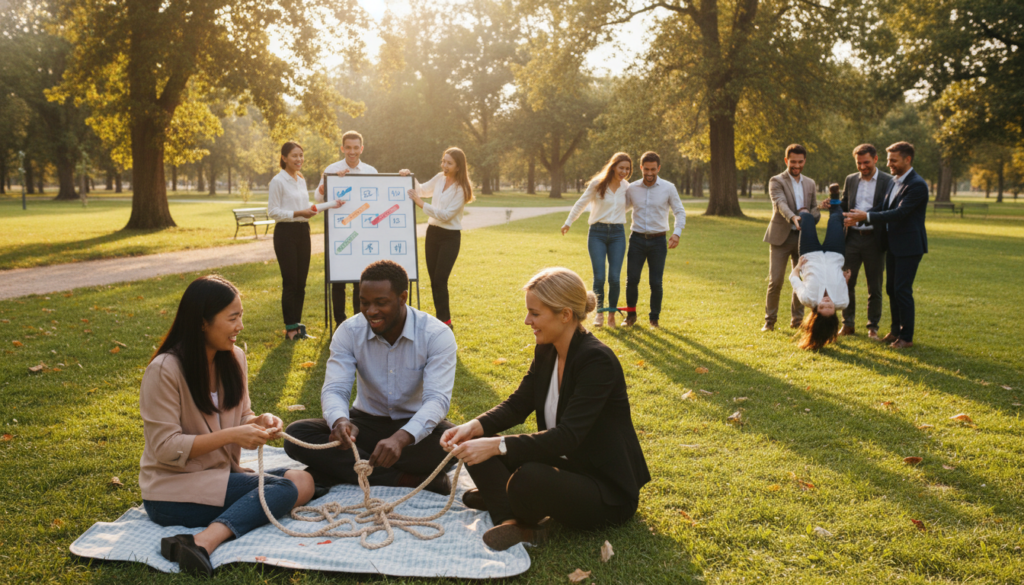
We position KPI-driven engagement as a practical morale strategy that drives measurable change in Malaysian organisations. By naming the outcome first—communication, trust, retention—we pick the right intervention and track real signals.
Sandmerit KPI is our recommended performance management system to plan, assign and measure these efforts. Sandmerit KPI links each session to clear metrics so leaders can show gains in clarity, fewer misunderstandings, and better cross-group cooperation.
Our list gives quick energizers, low-prep games, deeper bonding sessions, and remote-friendly options. Each item includes simple pulse checks and debrief steps to report outcomes credibly. We note Malaysian nuances—mixed seniority, multilingual groups, and distributed setups—and suggest inclusive facilitation.
Want a guided session? Whatsapp us at +6019-3156508 to discuss facilitation and KPI mapping with Sandmerit KPI.
Key Takeaways
- Use KPI-first planning to choose actions that meet clear goals.
- Sandmerit KPI helps measure impact and link sessions to results.
- Mix short energizers and deeper sessions to suit different schedules.
- Measure with pulse checks and structured debriefs for credible reporting.
- Design inclusive formats for mixed seniority and multilingual groups in Malaysia.
Why KPI-driven team building matters for morale and performance
Linking activities to KPIs turns goodwill into measurable improvements in everyday collaboration. When we set clear targets, people spot progress in how they work together and stay motivated to sustain new habits.
How shared experiences build trust and collaboration
Shared experiences create a safer space to try new behaviours. Doing something outside routine lets colleagues drop formal roles and practise asking for help.
“Shared experiences help teams build trust and encourage collaboration.”
Business outcomes beyond just having fun
We link morale to visible signals: faster alignment, fewer repeat misunderstandings, and greater willingness to support colleagues.
- Stronger relationships: clearer communication loops and more consistent collaboration across roles.
- Retention and engagement: employees stay when they feel valued and connected.
- Productivity gains: motivation rises when teams reset and reconnect with shared goals.
Each section below maps specific methods to KPIs so leaders can justify time spent and measure impact, not just run games. Learn practical facilitation tips in our how-to guide.
What team building is and what it’s designed to change
We design brief, purposeful sessions that change how colleagues interact and get things done.
Team building is a structured process that reshapes relations, coordination, and execution—not just social time.
Building connections, working practices, and stronger teamwork
We separate relationship work from effectiveness. One strengthens bonds; the other improves daily processes.
Good building activities are short, self-contained exercises with clear instructions and a debrief that turns learning into action.
Why this matters: stronger connections speed decision-making and raise the quality of collaboration under real deadlines.
- Core shifts we aim for: better information flow, clearer decisions, and healthier conflict.
- Different groups need different intensity: new groups use quick connection mechanics; established groups do deeper reflection.
- We choose an activity based on the change we want to see in the next 2–6 weeks.
| Focus | Typical exercise | Short-term KPI |
|---|---|---|
| Connections | Speed sharing rounds | Increase cross-checks in 2 weeks |
| Working practices | Role-play process handovers | Fewer handover errors in 3 weeks |
| Decision clarity | Quick consensus drills | Faster decision time within 4 weeks |
Next, we pick KPIs that match the change desired and measure impact during and after the session.
Choosing the right KPIs before we pick an activity
Before picking an exercise, we define which signals will show progress. This KPI-first method makes sessions intentional and measurable.
Communication skills and clarity
What we track: fewer rework cycles, clearer handoffs, and improved listening behaviors in meetings. We use short pulse questions and meeting audits to capture change.
Collaboration across teams and departments
Silo-reduction signals: faster cross-functional response times, fewer “blocked by” escalations, and more shared ownership language. These KPIs guide whether we pick coordination drills or cross-role problem solving.
Trust, psychological safety, and openness
Observable indicators include more questions asked early, quicker surfacing of risks, and healthier disagreement without shutdown. When trust is the goal, we choose deeper sharing and reflection exercises.
Engagement, motivation, and retention signals
We measure participation levels, energy shifts, and follow-through on agreed actions. Leaders can also monitor eNPS items, intention-to-stay questions, and manager check-in patterns as proxies for employees retention. Documenting a clear baseline lets us show movement after the session.
How we measure impact during and after the activity
A lightweight measurement routine helps us spot real movement after each session. We set clear objectives, gather quick feedback, and keep the environment stress-free so members can participate openly.
Simple pre- and post-session pulse checks
We use a 2–5 minute pre-pulse and post-pulse aligned to the chosen KPI. These short surveys fit into normal time and give an immediate baseline and outcome.
Sample pulse items: scaled questions on clarity, trust, and collaboration. We compare shifts right after the session to show quick wins.
Debriefs that capture insights and next actions
During the exercise we observe participation spread, turn-taking, and whether the group self-organizes or relies on one voice.
Debriefs answer: what happened, what helped or hurt, and what we will do differently next sprint. We capture 1–3 commitments, assign an owner, and set a check-in date.
“Short checks and clear next steps turn one-off sessions into lasting practice.”
| Measure | Method | Output |
|---|---|---|
| Clarity | Pre/post pulse (1–5) | Shift in mean score |
| Participation | Facilitator observation | Notes on spread and dominance |
| Follow-through | One-page recap | 1–3 actions, owner, check-in |
We review feedback after 2–4 weeks to see whether changes stick. This feedback loop helps us improve engagement and refine the way we measure each activity.
Team building activities for work that get people talking fast
Quick, low-risk warmups can spark real conversation the moment people enter the room. These short games create momentum in the first 10 minutes and lower social friction before any agenda begins.
Two Truths and a Lie style sharing
Setup: each member offers three statements—two truths and one lie—and the group guesses the false item. Use optional light prompts (hobbies, unusual jobs) to keep it inclusive.
Tip: avoid sensitive topics and give a “pass” option so no one feels forced to disclose personal details.
Best and Worst question draw
Participants write a “best/worst” question, drop it in a hat, then draw and answer. This draws deeper stories without pressuring anyone to overshare.
Tune prompts to workplace relevance—customer wins, lessons learned, proud moments—to surface useful insights and learning points.
Open Fist commonalities
Ask each person to list up to five little-known facts. Groups scan for overlaps. In five minutes this reveals shared interests and quick cohesion.
Timing: 5–15 minutes each; ideal group sizes are 5–15 people. Measure impact by tracking connection density and follow-up collaboration in the next sprint.
Debrief prompt: “What did we learn about how we connect, and how can we use that in our next project?” Use this to convert a short session into concrete next steps.
Icebreakers that work even when teams are new or rebuilding rapport
When groups are new or recovering from change, short icebreakers speed trust and practical links between members. We pick simple formats that scale, are respectful of cultural norms in Malaysia, and give measurable lifts in familiarity.
3 Question Mingle
Materials: sticky notes and a one-minute timer. Each person writes three questions on separate notes. Pairs meet for 60 seconds, ask one question each, then swap notes and rotate.
KPI benefit: structured one-on-one networking increases rapid familiarity and supports cross-group collaboration later.
Group Order line-up
Ask the group to line up by a criterion (birth month, years with company) without talking. Nonverbal constraints force problem framing and quiet cooperation.
Name Juggling
Toss a soft ball while saying names. Add more balls to raise energy. Use a clear safety note about space and soft props.
Why it works: raises attention, recall, and positive camaraderie in the room.
Cross the Circle
Stand in a circle and step across on prompts that are culturally respectful and job-appropriate. Prompts surface shared experiences without pressure.
Facilitator tips: timebox each round, split large groups into multiple circles, and keep instructions crisp.
Debrief template: “What helped us coordinate quickly, and what do we want to repeat in meetings?”
Communication skills games to reduce misunderstandings at work
Practical exercises sharpen how we give and confirm directions during handoffs. These two simple games train clear speaking, listening, and nonverbal cues so groups make fewer errors and move faster.
Back-to-back drawing
Pairs sit back-to-back. One person describes a simple image while the other draws using only the spoken instructions.
- Rules: no naming the object, no pointing, single-sentence prompts, one-minute turns.
- Good instructions: short steps, explicit references (left/right, top/bottom), check-ins like “Do you want me to repeat?”
- Recommended images: basic floor plan, simple gadget sketch, or flow arrow layout.
KPIs: clarity and quality — expect fewer rework cycles and faster handoffs after repeated practice.
Awareness Circle
Participants form a circle and interact silently to complete a simple task. This highlights nonverbal signals, inclusion, and observation skills.
Facilitation: opt-in movement, clear boundaries, and a safety pause. Offer an alternative for any person who prefers not to move.
Debrief: map behaviours to daily habits: confirm understanding, paraphrase, and ask clarifying questions. Capture agreements like “pause and paraphrase” and repeat these exercises quarterly as a skills refresher.
Trust-building exercises that strengthen openness between team members
Trust is the hinge that lets honest signals flow and failures surface early. Without it, teams hold back, delay risk escalation, and collaborate defensively. We design three compact formats that create measurable shifts.
9 Dimensions reflection
Participants mark red/green/yellow/blue dots across nine dimensions to show what’s “crushing it” versus needs work.
We protect psychological safety by using anonymous dots and small-group debriefs. Results become 1–2 clear commitments owned by members and tracked in the next sprint.
Personal Presentations
Each member prepares a short presentation with three shaping experiences and one skill they offer. Timebox to 4–6 minutes each.
This storytelling expands the social arena and reveals practical skills people can call on. Offer drawing or notes as low-pressure sharing options.
Happiness exercise
We use appreciative inquiry to surface positive stories and appreciation. This raises morale and improves engagement after tough periods.
| Format | Duration | Output |
|---|---|---|
| 9 Dimensions | 20–30 min | 2 commitments, heatmap |
| Personal Presentations | 30–45 min | Skill list, empathy gains |
| Happiness exercise | 10–20 min | Appreciation notes, energy lift |
What we measure: perceived safety to speak up, willingness to ask for help, and the quality of feedback exchanged. We document next actions so trust shows up in meetings and projects, not only during the session.
Problem-solving and collaboration activities for real-world teamwork
These problem-solving formats put people into short, high-stakes simulations of daily deadlines. They mirror ambiguity and pressure so groups practise making quick, shared choices.
Escape room challenges
Why use it: an escape room sharpens collaboration and leadership under time limits. Observe role emergence, communication patterns, and how fast decisions form.
What to watch: who organizes information, how clues are shared, and how stress affects clarity. Link observations to KPIs like decision speed and cross-role coordination.
Human Knot
Groups of seven to twelve link hands and untangle without breaking the chain. This simple game trains self-organization and clear verbal cues.
- Form a circle and join hands randomly.
- Without letting go, untangle into a circle.
- Debrief on who suggested moves and how consensus formed.
Safety note: offer an opt-out and allow gentle loosening to respect physical comfort.
Back of the Napkin solution sketching
Small groups sketch a solution to a real problem on a napkin, then present a 2-minute pitch. Keep prompts short and practical to encourage creative thinking and fast alignment.
Presentation guide: state the problem, show the sketch, name one owner and one next step.
| Exercise | Observation focus | Short-term KPI |
|---|---|---|
| Escape room | Role emergence, clue flow, decision speed | Faster consensus under time pressure |
| Human Knot | Self-organization, communication clarity | Increase in distributed leadership signals |
| Napkin sketch | Solution clarity, ownership, creative idea quality | Speed to consensus and assigned owners |
Measure impact by tracking speed to consensus, clarity of chosen solution, and cross-functional ownership in the next two sprints. These metrics show whether people truly learned to work together under pressure.
Creativity and innovation building activities for modern teams
A quick shift in perspective often unlocks fresh solutions to stale problems.
We use two short formats to reset how people think and to spark practical ideas that lead to follow-up experiments.
What would “X” do?
Concept: Participants pick a well-known figure or leader and brainstorm with that mindset.
This breaks habitual thinking by forcing an external lens. We suggest workplace-appropriate choices like famous entrepreneurs, historical inventors, or respected product leaders.
Measure: count distinct solution directions, run a novelty vote, and time the shift from idea to prototype.
Paper plane challenges
Groups design and iterate paper planes to compete on distance, accuracy, and durability.
Materials: simple paper, tape, and a tape measure. Rules are short and inclusive: one designer rotates roles every round.
This playful game trains rapid prototyping and collaborative skills while keeping the session light and fun.
| Exercise | Duration | Output |
|---|---|---|
| What would “X” do? | 20–30 min | 5–8 solution directions, 1 selected concept |
| Paper plane challenge | 15–25 min | Prototype iterations, performance scores |
| Both | 30–45 min total | Action list, owners, test plan |
Debrief: map ideas to quick tests, assign owners, and set a one-week check-in. We document best ideas in a shared board so follow-through is visible and measurable.
Low-prep games that reinforce company knowledge and shared wins
A focused trivia quiz makes KPI language stick while keeping energy light. Office Trivia Challenge is a low-prep format that scales and feels playful, not like training.
Office Trivia Challenge: setup and structure
We prepare 15–20+ questions about company facts, values, recent wins, and KPI awareness prompts. Mix factual items with short scenarios to make metrics memorable.
- Question mix: culture and values, “how we work,” customer impact stories, and light-hearted office facts.
- Scoring: round points, bonus question on KPIs, and a small prize to boost engagement.
- Format: small groups, timed answers, or chat-based rounds for remote employees.
Remote tip: use shared slides and breakout rooms or chat polls so everyone can answer, even in hybrid Malaysia settings.
“Which KPI surprised us?” and “Which value did we see in action this quarter?”
Run quarterly as a culture touchpoint to keep company language aligned and to improve cross-team understanding. Learn facilitation tweaks and question templates at our guide.
Quick energizers for meetings when we’re short on time
When minutes matter, a brief shared ritual can reset attention and lift energy. That quick reset helps everyone arrive mentally in the same place before a focused agenda.
Sync Claps: create presence and alignment
What it is: participants stand in a circle and “send” a clap around. Each clap pairs two people. Speed can increase, and a double clap reverses direction as a challenge.
How to run it:
- Form a circle with equal spacing in the room.
- Start slow: person A claps with B, B claps with C, and so on.
- Gradually increase pace. Introduce a double clap to change direction safely.
Why it works: Sync Claps creates shared focus, instant feedback, and a low-risk coordination challenge. It trains timing, signaling, and quick adaptation in a simple way.
- Small room tip: split into two smaller circles to keep clarity.
- Large group tip: stagger starts or use sub-groups so everyone stays in sync.
- Inclusive note: make participation opt-in and allow non-contact spacing.
Debrief (1–2 minutes): ask, “What helped us synchronize?” and “How did we recover from mistakes quickly?” Use answers to link the exercise to daily communication norms. Use Sync Claps before tough discussions, after lunch dips, or at an all-hands start to reset energy.
Team bonding activities that create deeper connections (not just small talk)
When morale dips, focused bonding formats reconnect people to shared stories and practical empathy. These sessions help members see the person behind the role and restore everyday cooperation.
Life Map: meaningful reflection and shared understanding
Life Map asks each person to draw or collage key moments from their life and share what shaped them. Timebox to 20–30 minutes with a 2–3 minute share per person.
Boundaries: set optional prompts, a “pass” option, and a reminder that personal details won’t be recorded. This keeps sharing safe and respectful.
Four Quadrants drawing: visual sharing that includes introverts
Draw a simple 2×2 grid and answer four prompts with images or keywords. This visual method suits reflective members and reduces pressure to perform verbally.
- Sample prompts: proud work moment, stress signal, strength I bring, support I need.
- Facilitation: assign equal airtime, use a timer, and ask listeners to paraphrase one insight each.
- Privacy: capture themes and agreements only—no personal notes or recordings.
Debrief: ask, “How will we support each other better next sprint?” Record 1–3 shared commitments and owners so connections translate into everyday practice.
“Meaningful sharing builds context that reduces misinterpretation and strengthens trust.”
Virtual and remote-friendly team-building activities for distributed teams
When people are apart, simple, structured moments of sharing restore real rapport. Our aim is to recreate the small human moments that happen naturally in offices while keeping participation fair across locations and time zones.
Show and tell: object sharing to connect beyond roles
How it runs: 2–3 minutes per person. Each member shows a meaningful object and says why it matters.
Why it helps: curiosity leads to personal stories and faster cross-group familiarity.
Photo caption contest to spark lighthearted collaboration
Collect humorous images, have small groups write captions, then vote. Use short rounds to keep energy high.
Result: quick laughs, low-risk exchange, and a lift in informal collaboration.
Online trivia using interactive tools
Run live quizzes with Kahoot or Quizizz. Mix general questions with a few company/KPI items to align learning.
- Schedule sessions during normal hours and note time zones so no one is excluded.
- Keep rules simple and test tech before launch.
- In hybrid settings, use chat, round-robin speaking, and mixed breakouts so everyone contributes equally.
Measure impact: track participation rate, cross-team interaction frequency, and short qualitative feedback on belonging. Rotate hosts each month to increase ownership and sustain engagement.
How we run inclusive, high-participation sessions in Malaysia workplaces
Our approach centres accessibility and clear goals so every participant can join with confidence. We design sessions to suit mixed seniority, varied language comfort, and different physical abilities common in Malaysia.
Inclusivity across comfort levels, roles, and physical ability
We offer multiple ways to contribute: speaking, writing, drawing, or small-group sharing. This ensures each employee can join without pressure.
We set opt-out paths, clear boundaries, and facilitator modelling to protect psychological safety and build trust.
Clear objectives so every activity has a purpose
Every exercise links to a stated KPI and a business behaviour we want to see. We brief leaders and participants at the start so the session feels human but taken seriously.
Feedback loops to continuously improve employee engagement
We use a quick post-session survey, a short debrief, and a 2–4 week follow-up to track engagement shifts. Practical Malaysia logistics — timing, venue access, and inclusive refreshments — are planned in advance.
Result: inclusive facilitation raises participation rates and improves the quality of outcomes across teams and daily communication.
Planning checklist: matching group size, time, and setting to the right activity
Selecting the right session starts with a short planning checklist. We align objective, participant count, available time, and room type before choosing an activity. This reduces last-minute changes and keeps outcomes measurable.
Small groups vs. large groups: what changes in facilitation
Small groups need concise instructions and a single facilitator who guides reflection and assigns owners. We use tight prompts and one-minute check-ins to keep pace.
Large groups require clear scripting, breakout corners, and at least one facilitator per 8–12 participants. We plan parallel runs so every person can contribute and we can observe participation spread.
In-office, offsite, and event-space considerations
In an office, choose seated or low-movement formats and be mindful of nearby teams. An event space gives us freedom for movement games and louder exercises.
Offsite or rented venues often improve focus and novelty but add logistics: AV checks, seating flexibility, and catering arrangements. For virtual sessions, confirm bandwidth and breakout room setups in advance.
Quick planning checklist
| Constraint | What to pick | Notes |
|---|---|---|
| Group size: 4–10 | Reflection, deep sharing | One facilitator; longer turns; privacy helps trust |
| Groups: 11–30 | Breakouts, parallel exercises | Multiple facilitators; structured rotations |
| Time: 5–10 min | Energizers | Anywhere; minimal setup |
| Time: 15–30 min | Icebreakers | Seated or small movement; breakout corners useful |
| Time: 60–120+ min | Workshops, deeper sessions | Private room or event space; AV and materials checked |
- Space needs: open room for movement, seated setups for reflection, and small corners for parallel groups.
- Risk & accessibility: check movement intensity, materials, and provide opt-in alternatives to stay inclusive.
- Align to KPI: trust work benefits from privacy; energizers can run in any office area.
Final confirmation: objective, agenda, materials, facilitator count, room booking, and measurement plan. Tick these off before you begin.
Book a KPI-driven team building session with us in Malaysia
Schedule a short intervention that targets one or two measurable outcomes and delivers quick gains. We design sessions to fix a pressing problem—communication clarity, cross-team collaboration, trust repair, or an engagement lift.
Whatsapp us at +6019-3156508.
To scope the session, tell us: preferred date, location (in-office/offsite/virtual), approximate headcount, seniority mix, time available, and the top 1–2 KPIs you want to move.
Typical engagement includes: KPI selection, matched activity choice, facilitation, pulse measurement (pre/post), a short debrief, and a one-page recap with next actions.
We keep facilitation practical and workplace-appropriate so teams can apply changes immediately after the session. Quick slots fit meeting windows; longer workshops suit deeper repair and strategy alignment.
| What to message | What we need | Timeline |
|---|---|---|
| Preferred date & location | Headcount & seniority mix | We confirm availability within 24–48 hours |
| Top 1–2 desired outcomes | Time available (minutes/hours) | Draft plan in 48–72 hours |
| Any access or tech notes | In-office/offsite/virtual choice | Final brief 24 hours before session |
Ready to book? Message us on WhatsApp at +6019-3156508 with your preferred date, location, headcount, and desired outcomes. We’ll reply with a short proposal and clear next steps.
结论
The clearest path to better morale is simple: name one KPI, run a focused session, and measure the outcome.
We covered the main KPI buckets—communication, collaboration, trust, and engagement—and showed how short games, icebreakers, skills exercises, and problem-solving formats map to each signal.
Effective building is never random. Each activity ends with a debrief, 1–3 concrete next actions, and an owner so progress becomes visible.
Start small: run a five-minute energizer this week, then plan a deeper session next month. Make participation inclusive so every team member can join comfortably.
Practical nudge: pick one KPI, run one activity, measure pre/post, and repeat monthly to build momentum—and if you want help, book a KPI-driven session with us.
FAQ
What are KPI-driven team building activities and why do we recommend them?
KPI-driven sessions focus on specific, measurable outcomes such as improved communication clarity, faster collaboration across departments, higher engagement scores, or better retention signals. By defining metrics before we pick an exercise, we design experiences that deliver visible business value rather than only temporary fun.
How do shared experiences improve trust and collaboration at work?
Shared challenges encourage mutual reliance and reveal strengths and gaps in real time. When people solve problems together—whether in a short energizer or a longer escape-room style challenge—they practice giving clear instructions, listening, and adjusting. Those repeated micro-interactions build psychological safety and smoother handoffs across colleagues.
Which business outcomes can we realistically improve beyond morale?
Well-designed sessions can move KPIs like task handoff time, meeting efficiency, idea submission rates, and internal hiring referrals. We align each activity to one or two target metrics and use simple measures to show progress, so stakeholders see tangible returns on time invested.
What is the primary goal of these exercises?
The core goal is to change everyday behaviors—how we communicate, make decisions, and collaborate—so teams deliver better results together. Activities are chosen to influence connections, working practices, and sustained improvement in how people cooperate.
How do we choose the right KPIs before running a session?
We start with a short intake: group size, current pain points, and desired outcomes. From there we select KPIs such as communication clarity, cross-department collaboration, trust and psychological safety, or engagement and motivation. That upfront focus determines which exercises will move the needle.
How do we measure impact during and after an activity?
We use simple pre- and post-session pulse checks, quick numerical ratings, and short debriefs that capture insights and next actions. This combination gives immediate feedback and a baseline for follow-up measures like engagement surveys or productivity indicators.
Which low-prep exercises get people talking fast?
Quick sharing formats—like a Two Truths and a Lie variant or a Best and Worst prompt—spark candid exchanges in minutes. These methods require minimal setup, create rapport quickly, and surface commonalities that help later collaboration.
What icebreakers work when groups are new or rebuilding rapport?
Structured one-on-one rotations such as a 3 Question Mingle, nonverbal problem framing like Group Order line-up, and Name Juggling help people learn names, preferences, and small signals without forcing deep disclosure. They scale well and respect different comfort levels.
Which communication games reduce misunderstandings on projects?
Back-to-back drawing forces precise instruction and active listening, while Awareness Circle raises sensitivity to nonverbal cues. Both exercises create repeatable habits for clearer briefings and fewer revisions later.
How can we build trust and psychological safety through short exercises?
Reflective formats such as a 9 Dimensions check-in and Personal Presentations let people share work priorities and personal context at a paced level. Adding a Happiness appreciation exercise encourages positive recognition that strengthens openness.
What problem-solving activities transfer to real-world collaboration?
Timed challenges like an escape room teach leadership under pressure and rapid role-switching. Human Knot and Back of the Napkin sketching promote self-organization and quick alignment on solutions—skills we can bring into sprints and meetings.
How do creativity-focused exercises help modern teams?
Prompts that ask “What would [a famous innovator] do?” break habitual thinking. Paper plane challenges combine iterative prototyping, friendly competition, and feedback loops that encourage experimentation at low cost.
Are there low-prep games that reinforce company knowledge?
Office Trivia built around company facts, values, and KPI awareness requires almost no setup and reinforces shared expectations while boosting camaraderie and healthy competition.
What quick energizers work when we’re short on time?
Sync Claps and short presence exercises refocus attention, create alignment, and reset energy for the next agenda item without taking more than a minute or two.
Which bonding exercises go beyond small talk?
Life Map and Four Quadrants drawing encourage meaningful reflection and visual sharing. They create space for deeper connection while including quieter colleagues through structured prompts.
Which remote-friendly options work for distributed teams?
Show-and-tell object sharing, photo caption contests, and online trivia using interactive platforms help remote colleagues connect beyond tasks and build camaraderie across locations.
How do we run inclusive, high-participation sessions in Malaysia workplaces?
We design activities with multiple participation modes, respect cultural norms, and set clear objectives so each exercise has a purpose. We also build feedback loops to adapt facilitation and improve employee engagement continuously.
How should we match group size, time, and setting to an activity?
Small groups need tighter facilitation and more hands-on facilitation; large groups require scalable mechanics and clear roles. We consider in-office, offsite, and event-space logistics when selecting formats and timing to maximize impact.
How can we book a KPI-focused session with you in Malaysia?
Whatsapp us at +6019-3156508 to discuss objectives, group size, and preferred dates. We’ll propose a targeted plan with suggested KPIs, sample exercises, and measurement steps.