
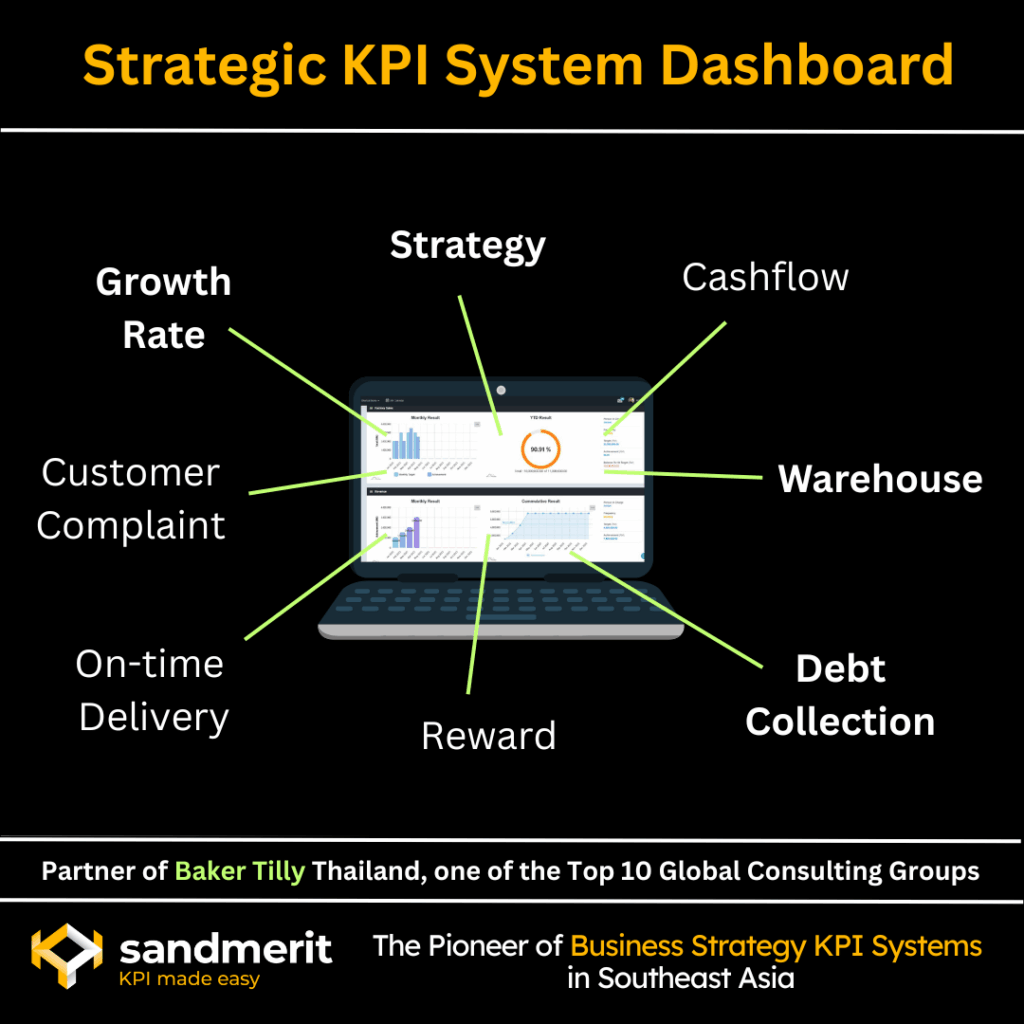
In an increasingly competitive and uncertain business environment, many organizations work harder every year but struggle to achieve consistent growth. Teams are busy, managers are overloaded, and CEOs feel pressure from all directions—yet results often fall short of expectations. The root cause is rarely a lack of effort. More often, it is the absence of a clear, structured, and fair kpi management system that connects strategy to daily execution.
A KPI management system is not just an HR tool. It is a business operating system that determines how decisions are made, how priorities are set, and how people are rewarded. When implemented correctly, it becomes the backbone of productivity, accountability, and long-term sustainability.
What a KPI Management System Is Really Meant to Do
At its core, a kpi management system serves one essential purpose: alignment.
It aligns:
- Company vision with operational execution
- Department objectives with organizational goals
- Individual effort with measurable outcomes
- Performance with fair and transparent rewards
Without this alignment, organizations rely on assumptions, personal judgment, or seniority-based decisions. Over time, this leads to frustration, internal politics, declining productivity, and high employee turnover.
A strong kpi management system eliminates ambiguity. Employees know what is expected. Managers know how to evaluate fairly. CEOs gain clarity over whether the organization is truly moving in the right direction.
Why Many KPI Initiatives Fail in Practice
Despite widespread awareness of KPIs, many companies still experience failure or resistance when implementing them. Common issues include:
- KPIs exist only in Excel files and are rarely reviewed
- Targets are unclear, unrealistic, or frequently changed
- Employees feel KPIs are subjective or unfair
- Managers spend more time managing reports than managing people
- KPI results are disconnected from rewards
These failures are not caused by KPIs themselves. They happen because companies focus on KPIs as metrics, rather than as a system.
A kpi management system must address human behavior, leadership alignment, communication, and motivation—not just numbers.
How sandmerit KPI 123 Is Fundamentally Different
This is where sandmerit KPI 123 distinguishes itself from conventional solution providers.
Most providers fall into one of two categories:
- Software companies that sell KPI tools without consulting support
- Training companies that teach KPI concepts without system implementation
sandmerit integrates consultancy, methodology, and technology into a single, cohesive kpi management system designed for real-world execution.
sandmerit KPI 123 is built on three structured pillars:
1. Leadership and Strategy First
sandmerit begins by working closely with CEOs and top management to clarify business direction, strategic priorities, and success definitions. KPIs are never designed in isolation. They are derived directly from business strategy, ensuring relevance and focus.
2. Organization-Wide Alignment
Through structured workshops and facilitation, sandmerit aligns management teams, department heads, and employees. KPIs are cascaded logically from company level to department level and finally to individual roles. Every KPI has a purpose, and every employee understands how their work contributes to the bigger picture.
3. System Automation and Transparency
sandmerit’s platform automates KPI tracking, scoring, and reward calculation. Performance data is visible, structured, and objective. This transparency builds trust and eliminates unnecessary conflict between employees and management.
This integrated approach transforms KPI from a compliance exercise into a performance driver.
A KPI Management System That Employees Accept
One of the strongest proofs of effectiveness is acceptance across all levels.
sandmerit has received more than 600 real testimonial videos, not only from CEOs, but also from managers and frontline employees. This level of adoption is rare in performance management systems.
The reason is simple: sandmerit emphasizes fairness and clarity. Employees understand how their KPIs are measured, how scores are calculated, and how rewards are distributed. When people trust the system, resistance disappears and engagement increases naturally.
Productivity Through Focus, Not Pressure
A common fear among employees is that KPIs will increase pressure. In reality, a well-designed kpi management system improves productivity by improving focus.
With sandmerit KPI 123:
- Employees prioritize high-impact tasks
- Managers reduce time spent on micromanagement
- Teams stop wasting effort on low-value activities
Productivity improves not because people work longer hours, but because they work on the right things.
The Expertise Behind sandmerit: Wilson Ten
The effectiveness of sandmerit KPI 123 is closely tied to the experience and philosophy of its founder, Wilson Ten.
Widely known as Malaysia’s KPI King, Wilson brings more than 23 years of hands-on experience focused exclusively on KPI and performance management. He has worked extensively with public-listed companies, multinational corporations, and SMEs across multiple industries and countries.
What makes Wilson unique is not just experience, but specialization. While many consultants treat KPI as one of many services, Wilson has dedicated his career to understanding why KPI systems fail—and how to make them succeed in real organizations.
His belief is clear:
KPI should not be a punishment mechanism. It should be a fair system that creates clarity, motivation, and shared success.
This belief shapes every aspect of sandmerit’s methodology.
Beyond Short-Term Results: Building Sustainable Organizations
Many KPI systems produce short-term improvements but fail to sustain momentum. sandmerit KPI 123 is designed for long-term impact.
By embedding KPI into daily operations, leadership culture, and reward systems, organizations build habits of accountability and continuous improvement. Over time, this leads to stronger execution, better talent retention, and improved financial performance.
A mature kpi management system also prepares organizations for scaling, restructuring, or even public listing by establishing governance, transparency, and predictability.
Why a KPI Management System Is No Longer Optional
As businesses face rising costs, talent shortages, and market volatility, relying on informal management or individual supervision is no longer sufficient. Organizations that succeed will be those that operate on systems—not personalities.
A robust kpi management system provides the structure needed to manage complexity while maintaining fairness and agility.
sandmerit KPI 123 represents a proven, human-centered approach to KPI implementation—one that bridges strategy, execution, and people. It is not about controlling employees, but about enabling organizations to perform at their best.
Hashtags
#wilsonten #kpiking #kpi #sandmerit #kpimanagementsystem #performancemanagement #productivity #businessgrowth #leadership #organizationalexcellence