
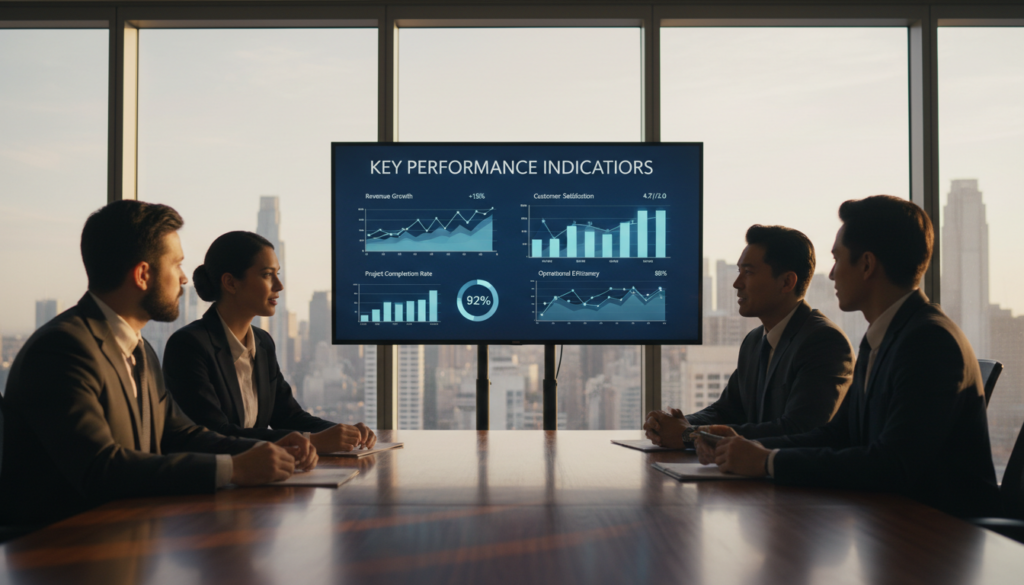
Did you know that companies that focus on a few clear metrics grow faster—often by more than 30% a year?
We start this guide with a practical promise: you will get a department-by-department set of measurable targets you can use today. Key performance indicators are the link between strategy and daily work. They tell us what we want to achieve and by when.
Our approach is simple. First, we cover fundamentals and how to write strong kpis. Then we share a KPI library by department and show how to track results with analytics and dashboards.
This guide is written for Malaysia-based companies—from SMEs to mid-market—but it uses globally accepted methodology. We focus on a tight set of metrics, not endless reports, so teams can make faster decisions.
Want hands-on help selecting the right measures? Whatsapp message us to know more about KPI @ +6019-3156508.
Key Takeaways
- We offer a practical, department-level set of KPI examples to manage performance.
- KPIs link strategy to day-to-day execution so teams see what success looks like.
- Structure: fundamentals, writing strong KPIs, departmental library, dashboards.
- Focused metrics drive business decisions for Malaysia SMEs and mid-market firms.
- Contact us via WhatsApp for direct support: +6019-3156508.
What Key Performance Indicators Are and Why They Matter for Business Goals
When we define success in numbers, decisions get faster and outcomes improve. Key performance indicators are defined measurements used to assess long-term performance against targets, objectives, or industry benchmarks.
Key performance differs from general metrics because it ties a measurable value to a target and a timeframe. Metrics can count activity; key performance indicators set the destination.
We compare actual results to benchmarks, past performance, or peers to measure progress. That comparison tells leaders when to prioritize initiatives, reallocate budget, or change course.
How they support decisions
These indicators guide strategic, financial, and operational choices. They prevent departments from optimizing locally at the expense of the company.
- Data flows from collection tools to dashboards.
- Reports move into management review.
- Teams convert insight into action plans.
Example: a healthier sales pipeline predicts revenue more accurately. When pipeline value drops, we increase lead investment early to protect forecasts and cash flow.
Indicators vs. Key Performance Indicators: What We Track and What We Don’t
Not every number your team tracks deserves a seat on the executive dashboard. An indicator can be any operational count or rate. But a key performance indicator must connect to company strategy, a target, and an owner.
Why not every performance metric qualifies
Many metrics fail as KPIs because they lack a target, a decision owner, or a link to business goals. Some signals are useful for operations but not for executive review.
How we tie indicators to company-wide goals
We ladder department indicators up to strategic goals. Each KPI must clearly show an outcome and a timeframe.
- Filter checklist: relevance, clarity, measurable outcome, actionability.
- Limit your executive set to ~7 KPIs to avoid noise and misalignment.
- Track operational indicators separately as early warnings, not dashboard KPIs.
To implement this, we map each KPI to a company objective and assign an owner. For help choosing the right dashboard metrics, see our software tools at performance dashboard solutions.
The Five Elements of a Strong KPI Statement
Strong KPI phrasing removes guesswork and speeds team action. Below we break the five elements that make a statement unambiguous and actionable for Malaysia teams.
Measure
Choose the right measure type: a raw number, a rate, a percentage, or a ratio. Match the type to the decision you need to make.
Target
Set a numeric target and a clear timeframe. Targets must be expressed as a number and tied to dates so progress is comparable over time.
Data source
Document where the data comes from: CRM, Google Analytics, ERP, or finance systems. This prevents disputes over which spreadsheet is “right.”
Reporting frequency
Define cadence: weekly when rapid response is needed, monthly as a rule, and quarterly for strategic review. Cadence affects how fast management can act.
Owner
Assign an owner in a department who is accountable for accuracy, interpretation, and follow-up when multiple teams share resources.
- Sample 1: Measure=New leads (number); Target=200 per month; Data source=CRM; Reporting frequency=Monthly; Owner=Marketing lead.
- Sample 2: Measure=Conversion rate (percentage); Target=5% by quarter end; Data source=Website analytics; Reporting frequency=Weekly; Owner=Sales ops.
How Many KPIs Should We Use to Stay Focused
We keep measurement tight so teams act quickly on what matters most. Good plans use 5–7 measures to manage progress against goals. A compact set helps us monitor the heartbeat of the business without creating reporting overload.
Why a small set works
Focus speeds execution. When we limit our list to five to seven, teams know which results to push and which efforts to pause. This reduces meetings and accelerates decisions.
How to pick the final set
- Choose measures that best predict success and flag risk.
- Ensure each item ties to a clear owner and a data source.
- Include a mix of company-wide and department-level kpis so the list stays lean but complete.
Tracking too many metrics dilutes efforts and creates noise. We recommend committing to the same set for about a year so trends become meaningful and targets stay stable.
Types of KPIs We Can Use to Measure Performance
To turn numbers into narrative, we classify measures into three distinct types. Each type answers a different question and helps teams act faster.
Broad number measures that count activity
These are raw counts: leads, orders, tickets, or users. A simple number is easy to track and shows scale.
Limitation: counts can miss context. A rising number does not always mean better outcomes.
Progress measures that track percent complete
Percent complete works well for projects and rollouts. The percentage shows how close we are to a milestone.
Use percentage when short-term outcome data is hard to capture but staged delivery matters.
Change measures that show improvement over time
Change measures quantify improvement—percent increase month over month or year over year. They make trends actionable.
Specific change targets focus teams: for example, a 15% reduction in response time or a 10% lift in pipeline value.
- We define when each metric type is most useful in planning and execution.
- We combine counts, percentage tracking, and change measures to create a clear performance story.
- In Malaysia operations, this mix helps when growing pipeline, speeding service, or tightening cash flow.
Leading KPIs vs. Lagging KPIs: Balancing Early Signals and Outcomes
Good dashboards pair forward-looking signals with clear outcome measures. This balance helps us act early and confirm results later.
Leading indicators that predict future business performance
Leading indicators are early warning buoys. They show trends that often move before revenue or profit changes.
Examples include cost-to-deliver trends, website ranking shifts, and ad click-through rates. These signals help us adjust spend, messaging, or delivery speed.
Lagging indicators that confirm past results
Lagging indicators confirm what already happened. Measures like EBITDA, quarterly revenue, and margin are final signals.
They are vital for reporting, but they arrive after decisions were made. Relying only on them makes management reactive instead of proactive.
How we build a balanced mix for growth and risk control
We combine early signals with outcome measures so teams can pursue growth while managing cost and margin risks.
- Pair pipeline quality (leading) with net sales growth (lagging).
- Monitor labour cost trends (leading) alongside profit margin (lagging).
- Use website engagement (leading) to protect future revenue forecasts.
Cause-and-effect chain: if ad click rates drop (leading), lead volume drops next month, then revenue falls that quarter (lagging). Acting on the click data early prevents the revenue gap.
Practical rule: design dashboards with at least two leading and two lagging measures so we stay agile and confirm outcomes with confidence.
How We Set KPIs Using Best-Practice Steps
We map each measure to a clear annual objective so our teams know what to aim for. This keeps goals visible and prevents metric drift across the company.
Start with objectives and define success
Identify measures tied to your organisation-wide goals for the year. Define success in numbers and dates so teams can plan work against a target.
Evaluate measure quality
Check relevance, clarity, and whether a measure produces a measurable outcome. Balance leading and lagging measures so management can act early and confirm results later.
Assign ownership and communicate
Give each measure a single owner and state how results will be used. Share the why and the target across the company so teams understand their role.
Monitor and review
Track results at least monthly and report trends to management. Review measures when market or operations shift and adjust targets as needed.
- Step-by-step: map to goals, quality-check the measure, assign an owner, communicate widely, monitor monthly.
- Practical rule: limit the executive set to a focused group so performance tracking drives action, not noise.
kpi examples by Department: A Practical KPI Library We Can Apply
Department-level measures show us why company outcomes move and where to act first. We introduce a compact KPI library that helps each team link daily work to business goals.
How to choose department KPIs that ladder up to goals
Pick measures that explain cause, not just outcome. For each objective define: Objective → KPI → owner → cadence → dashboard placement. This keeps ownership clear and reduces debate over definitions.
How to avoid tracking too many metrics at once
Limit each department to a small set of decision-driving metrics. When teams track 4–6 measures, they focus on actions that move the needle.
“Good department measures explain why a result occurred and point to the next action.”
| Level | Purpose | Cadence |
|---|---|---|
| Company-wide | Confirm outcomes and strategy alignment | Monthly |
| Department | Explain drivers and trigger actions | Weekly/Monthly |
| Project | Track delivery and milestones | Weekly |
- Shared KPIs: define a single source of truth so marketing and sales report the same acquisition metric.
- Adapt targets to Malaysian market conditions and review cadence after one quarter.
Sales KPI Examples to Track Revenue, Leads, and Conversion Time
Sales teams win when we measure both speed and value in the funnel. We list high-impact sales measures that show pipeline health, predictability, and conversion velocity. Below we explain what each number tells us and how to set practical targets.
Contracts signed and new contract value
What to track: number of contracts signed and dollar value of new contracts.
Why it matters: separating volume from value prevents us from celebrating more deals that shrink average sale.
Qualified leads, engaged leads, and lead conversion rate
Define qualified leads vs engaged leads consistently between sales and marketing. Use conversion rate as the share of qualified leads that become contracts.
Average sales cycle and average time for conversion
Measure average time from first contact to signed contract. A sample target: reduce average time from 60 to 45 days.
Net sales growth and new sales revenue
Report net sales growth as a percent and new sales revenue in dollars so leadership sees change and scale.
Customer acquisition count and pipeline health
Customer acquisition count and pipeline value are leading signals for next quarter revenue. Track counts alongside weighted pipeline to improve forecasts.
| Measure | Target | Data source | Frequency/Owner |
|---|---|---|---|
| Contracts signed (number) | +10% per quarter | Sales CRM (HubSpot) | Weekly / Sales Manager |
| New contract value (MYR) | Increase avg value 8% | ERP + CRM | Monthly / Head of Sales |
| Average time to close (days) | 60 → 45 days | Salesforce pipeline report | Weekly / Sales Ops |
| Lead conversion rate (%) | Improve to 18% | Shared CRM definitions | Weekly / Marketing & Sales |
Marketing KPI Examples to Measure Customer Acquisition and Campaign Performance
To measure marketing impact we match web signals to real customer acquisition outcomes. We focus on a small set of measures that show how campaigns turn visits into paying customers in Malaysia.
Traffic, SEO and high-intent keywords
Track monthly website traffic and organic traffic to see scale. Monitor high-intent keywords in top results to measure SEO contribution to lead flow.
Leads, handoffs and cost per lead
Define MQLs and SQLs with a clear handoff rule so Marketing and Sales agree on quality. Compare cost per lead against lead quality, not just number of leads.
Conversion rates for CTAs and landing pages
Measure CTA conversion rate and landing page conversion rate separately. Run A/B tests and avoid averages that hide segments that convert better.
Customer acquisition cost and CPA
Calculate customer acquisition cost (CAC) including ad spend, tools, and labour. Use cost per acquisition (CPA) to check whether new customers are profitable.
Social media and content output
Use social media engagement and social media traffic as early signals. Treat reach as a leading indicator, not the final goal.
Content output—blog articles and downloadable assets—must tie to pipeline influence. Track how assets generate MQLs and later customer conversions.
| Measure | Purpose | Cadence |
|---|---|---|
| Monthly organic sessions | SEO traffic & lead source | Monthly |
| MQL → SQL conversion rate | Handoff quality | Weekly |
| CAC / CPA (MYR) | Acquisition cost credibility | Monthly |
- Practical rule: pair two acquisition cost measures with two conversion rates so we see both spend and efficiency.
- Local tip: adjust targets for Malaysia market seasonality and channel mix each quarter.
Finance KPI Examples to Measure Profit, Cash Flow, and Financial Health
Good finance signals tell us when profit and cash diverge—and why. We focus on measures that go beyond top-line revenue so management can budget and act with confidence.
Revenue and product-level value
Track total revenue by product or service to see where real growth comes from. This shows which lines drive future margin and which drain resources.
Margins, cash flow and liquidity ratios
Compare gross, net and operating profit margin to reveal pricing, delivery cost, and overhead control. Monitor operating cash flow and the cash conversion cycle so profit percentage aligns with cash reality.
Turnover, working capital and budget control
Accounts receivable and payable turnover rates and working capital ratios are vital for liquidity. Use budget variance and operating expense ratio in monthly reviews to trigger spending controls.
“Financial ratios and cash metrics tell a clearer story than revenue alone.”
- Primary sources: financial statements, ERP and QuickBooks for accurate values.
- Use these measures for regular benchmarking and management review.
Customer Service KPI Examples to Improve Satisfaction and Retention
Tracking the right service numbers helps us keep customers and cut costly repeat work. We focus on measures that protect retention and lift lifetime value so leaders can see financial impact quickly.
Retention rate and lifetime value impact
Customer retention rate ties directly to lifetime value. A small rise in retention grows lifetime value materially, so we report both for leadership-level decisions.
Response and resolution time, plus first contact resolution
Average response time and average resolution time measure speed, but we segment both by issue type for accuracy.
First contact resolution rate balances speed with quality so we do not close tickets quickly at the cost of repeat contacts.
CSAT, NPS, and customer effort score
We use CSAT for transactional feedback, NPS for loyalty signals, and customer effort score to measure friction. To avoid sampling bias, rotate survey windows and stratify by customer segment.
Ticket volume, resolved tickets, and support costs
Ticket volume by request type and resolved tickets reveal product or process issues that increase demand. We track support costs and the support cost-to-revenue ratio to scale service efficiently as our customer base grows.
| KPI | Purpose | Cadence | Owner |
|---|---|---|---|
| Retention rate | Protect revenue & lifetime value | Monthly | Customer Success Lead |
| Avg response / resolution time | Measure speed by issue type | Weekly | Support Manager |
| CSAT / NPS / Effort | Measure satisfaction and loyalty | Post-interaction / Quarterly | Head of CX |
| Support cost-to-revenue | Control service cost as customers grow | Monthly | Finance & Ops |
For a practical checklist of the most valuable support measures we track, see customer support metrics to track.
Operations KPI Examples to Improve Efficiency, Quality, and Time
Operations link process discipline to the customer promise. We measure the steps that matter so delivery is reliable and margins improve.
Order fulfillment time and total cycle time
Map each step from order receipt to product delivery to spot where time is lost. Measuring order fulfillment time and total cycle time helps us prioritise fixes that reduce lead times and improve on-time delivery.
Time to market and project schedule variance
Track time to market for new products and monitor project schedule variance. These measures show whether releases meet planned dates and reveal bottlenecks that slow product improvements.
Inventory turnover ratio and throughput
Use inventory turnover ratio and throughput to see cash tied up in stock. Healthy turnover and higher throughput free working capital and raise performance across the supply chain.
Error rate, rework rate, and quality rate
Define error and rework rates clearly so quality rate reflects customer outcomes. Reducing defects lowers cost, cuts complaints, and protects margin.
Resource utilization and labor utilization
Measure resource and labor utilization to balance capacity and avoid burnout. We use these rates to improve efficiency without sacrificing safety or product quality.
Result: better time performance, fewer complaints, and lower cost per product—real gains that show up in both customer satisfaction and the bottom line.
HR KPI Examples to Track Employee Engagement, Turnover, and Workforce Health
A focused set of HR measures protects execution capacity, service quality, and operational continuity. We track a few clear employee numbers so management sees early warning signs and can act before productivity drops.
Employee turnover rate, churn, and retention
Measure employee turnover rate and separate voluntary from involuntary churn. That distinction points to retention issues versus restructuring.
How we use it: set a target retention rate by department and review monthly to spot rising churn before it affects delivery.
Absenteeism rate and overtime hours
Absenteeism rate and overtime hours are early signals of burnout or staffing gaps. Rising numbers usually precede lower performance.
We monitor both weekly for high-risk teams and act by rebalancing workloads or hiring sooner.
Employee satisfaction and engagement surveys
Run consistent satisfaction and engagement surveys at regular intervals so trends are comparable year to year. Use the same questions and sampling approach.
Why it matters: satisfaction scores guide retention efforts and development plans that improve long-term performance.
Recruitment funnel, quality of hire, and time-to-fill
Track number of applicants, interview-to-offer conversion, quality of hire, and time-to-fill. Faster hires with high quality shorten the time until new staff contribute to company goals.
Assign ownership to HR and list cadence in monthly management reviews so hiring efforts align with department needs without creating surveillance-like reporting.
| Measure | Purpose | Cadence |
|---|---|---|
| Employee turnover rate | Protect capacity & retention | Monthly |
| Absenteeism / overtime | Early burnout signals | Weekly |
| Satisfaction / engagement | Track wellbeing & intent to stay | Quarterly |
| Time-to-fill / quality of hire | Hiring efficiency & productivity | Monthly |
Practical rule: limit HR tracking to a tight set of measures, assign a clear owner, and review results monthly so workforce health supports business goals in Malaysia.
IT KPI Examples to Measure Reliability, Tickets, and Delivery
Reliable systems start with clear measures for support volume, downtime, and delivery capacity. In Malaysia operations, these numbers link IT work to business continuity, customer experience, and cost control.
Total support tickets, reopened tickets, and resolution performance
What we track: total support tickets, reopened tickets, mean time to resolution (MTTR), and first contact fix rate. These figures show whether fixes stick or problems recur.
Why it matters: rising ticket counts or high reopen rates signal process or product issues that reduce productivity and raise support cost.
System downtime and critical bugs
We measure total downtime minutes, number of critical bugs, and severity-weighted outage time. Set severity rules so reporting stays consistent across teams and vendors.
Downtime impacts operations and customer experience directly, so we monitor outages weekly and trigger incident reviews when thresholds are met.
Projects on budget and delivery capacity per end users
Track percent of projects delivered on budget, delivery velocity, and IT support employees per end user. These numbers show whether resources match demand and whether projects align with company priorities.
Cost visibility: compare IT costs vs revenue to inform management decisions without sacrificing security or resilience.
- Reporting cadence: weekly for outages and tickets; monthly for projects, budget, and cost ratios.
- Use owners for each measure so follow-up actions are timely and clear.
How We Track KPIs with Dashboards and Reports (and When to Take Action)
Dashboards turn raw data into a repeatable management rhythm that keeps teams focused. We use dashboards and scheduled reports to track progress, compare results to targets, and prompt timely fixes.
What to include in dashboards
Every dashboard shows the definition, target, trend, owner, and current status vs goal. We include the data source and calculation note so numbers remain trusted.
Monthly vs weekly reporting
Report at least monthly for company-level margin, cash, and strategic measures.
Use weekly cadence for fast-moving performance indicators like pipeline movement, ticket backlog, and campaign conversion. Faster cadence helps us correct course before outcomes slip.
From results to action
Set thresholds that trigger investigation and corrective actions. For example, a 10% drop in pipeline value opens a review; a 20% gap from target triggers a corrective plan and owner sign-off. Document actions and outcomes in the report so follow-up is clear.
| Audience | Content | Cadence |
|---|---|---|
| Executives | Top-line trends, targets, risks | Monthly |
| Department leads | Drivers, owners, weekly trends | Weekly |
| Operations | Process metrics, backlog, actions | Daily/Weekly |
Data hygiene matters: use one source of truth, store definitions centrally, and avoid multiple spreadsheet versions. Analytics tools should compare live results to targets so we draw robust conclusions and decide if system or process changes are needed.
Need help selecting kpi examples for your Malaysia company? Whatsapp message us to know more about KPI @ +6019-3156508.
Conclusion
Clear measures and agreed owners keep teams focused on outcomes, not activity.
We summarise core principles: key performance indicators must tie to business goals, include the five strong statement elements, and be reviewed regularly so they stay relevant. A focused set—often five to seven—helps management act fast and avoid reporting noise.
Balance leading and lagging signals, choose department-level kpi examples that ladder to company outcomes, and always define data sources and owners so reporting stays credible during staff changes.
Finally, implement dashboards and use thresholds as decision triggers, not passive monthly updates. For help choosing the right measures for Malaysia firms, Whatsapp message us to know more about KPI @ +6019-3156508.
FAQ
What are key performance indicators and why do they matter for business goals?
We define key performance indicators as measurable values that show how well we’re achieving strategic, financial, and operational objectives. They matter because they turn high-level goals into clear targets, help prioritize resources, and guide decisions across marketing, sales, finance, and operations.
How do indicators differ from key performance indicators?
Not every performance metric qualifies as a key indicator. We treat indicators as raw measures of activity or output, while true KPIs must tie directly to company-wide goals, have clear targets, and drive action. That distinction keeps our teams focused on the metrics that matter most to growth and profitability.
What are the five elements of a strong KPI statement?
A robust KPI includes the measure (a number, rate, percentage, or ratio), a specific target and timeframe, the data source, a reporting frequency (weekly, monthly, quarterly), and a named owner accountable for results.
How many KPIs should we track to stay focused?
We recommend a small, prioritized set—often five to seven—per plan or department. Too many metrics dilute attention and stretch resources; a compact set keeps teams aligned and makes performance easier to monitor and improve.
What types of KPI measures can we use to assess performance?
We use three broad types: count measures that capture activity volume, progress measures that show percent complete, and change measures that reflect improvement over time. Combining these gives a fuller picture of current performance and momentum.
What’s the difference between leading and lagging indicators?
Leading indicators predict future performance—like qualified leads or website intent signals—helping us act early. Lagging indicators—such as revenue, profit margin, or customer retention—confirm outcomes after the fact. We balance both to manage growth and control risk.
What steps do we follow to set effective KPIs?
We start with clear objectives and define success, evaluate each KPI for relevance and measurability, assign ownership, and communicate company-wide. We then monitor consistently and review KPIs as conditions change to keep them useful.
How do we choose department-level KPIs that support company goals?
We map departmental metrics to strategic objectives, selecting measures that ladder up to top-line targets. For example, marketing KPIs should feed lead and acquisition goals, while finance KPIs must support revenue and margin targets.
Which sales indicators should we track to measure revenue performance?
We track contract value and new sales revenue, qualified and engaged leads, lead conversion rate, average sales cycle, net sales growth, and customer acquisition counts to keep a clear view of pipeline health and conversion effectiveness.
What marketing metrics matter for customer acquisition and campaign ROI?
We focus on monthly and organic website traffic, high-intent keyword rankings, MQLs and SQLs, cost per lead and cost per acquisition, conversion rates for landing pages and CTAs, social media engagement, and content output to measure campaign impact and customer acquisition efficiency.
Which finance KPIs show the company’s financial health?
We monitor revenue growth by product or service, gross and net profit margins, operating cash flow, cash conversion cycle, accounts receivable and payable turnover, working capital ratios, and budget variance to track profitability and liquidity.
What customer service measures drive satisfaction and retention?
Key measures include retention rate and customer lifetime value impact, average response and resolution times, first contact resolution, CSAT, NPS, customer effort score, ticket volume by type, and support cost ratios to revenue.
Which operations KPIs help improve efficiency and quality?
We track order fulfillment and total cycle time, time to market, inventory turnover, throughput, error and rework rates, quality rate, and resource and labor utilization to reduce waste and speed delivery.
What HR metrics should we use to monitor workforce health?
Important measures include employee turnover and retention rates, absenteeism and overtime hours, engagement and satisfaction survey scores, recruitment funnel metrics, quality of hire, and time-to-fill.
Which IT indicators measure reliability and delivery performance?
We watch total and reopened support tickets, resolution performance, system downtime and critical bugs, project delivery on budget, and delivery capacity per end user to maintain service levels and project outcomes.
What should a KPI dashboard include and when should we take action?
Our dashboards show targets, trends, owners, and variance to plan. We use weekly reporting for operational indicators and monthly reporting for broader performance. When metrics breach thresholds or trends reverse, we trigger management reviews and corrective actions.
How do we measure customer acquisition cost and lifetime value together?
We calculate acquisition cost per customer and compare it to customer lifetime value to assess payback and profitability. That ratio informs marketing spend, pricing, and retention strategies to maximize long-term value.
Can you help select KPI measures for a Malaysia-based business?
Yes. We tailor KPI selection to local market dynamics, customer behavior, and your industry. Whatsapp message us to know more about KPI @ +6019-3156508.