
When business owners and HR leaders search for key performance indicators for managers, most of them are looking for a simple list they can copy and paste into a KPI form. They want something practical that helps managers perform better, improve team results, and create stronger accountability.
But after more than two decades of working with companies across multiple industries, one truth becomes very clear:
The best key performance indicators for managers are not just “metrics.”
They are a leadership system.
Managers are the bridge between strategy and execution. They translate the CEO’s direction into daily actions, and they shape the culture of the team. That’s why companies that want real growth cannot only measure employee performance—they must measure managerial leadership effectiveness.
In this article, we will explore what managers should be measured on, what KPIs truly drive Productivity, and how sandmerit KPI 123 helps companies build a KPI management system that works in real life, not just on paper.
Why Key Performance Indicators for Managers Are the Most Important KPIs in the Company
In every organization, managers are the “multiplier.”
A strong manager can turn an average team into a high-performing team.
A weak manager can destroy the motivation of even the best employees.
That is why the right key performance indicators for managers create a powerful impact on the whole company.
Managers influence:
- output and productivity of the department
- quality control and error prevention
- employee engagement and retention
- cross-department coordination
- customer satisfaction
- cost efficiency and profitability
If a company only measures employee KPIs but ignores manager KPIs, the performance management system becomes incomplete.
Because employees execute tasks, but managers control execution quality.
The Biggest KPI Mistake: Measuring Managers Like Staff
Many companies design KPIs for managers by copying the KPIs of employees.
For example:
- “submit report on time”
- “complete tasks assigned”
- “follow SOP”
These are basic responsibilities. They are not managerial outcomes.
A manager’s job is not to “do work.”
A manager’s job is to lead people, manage processes, and deliver results through a team.
That’s why key performance indicators for managers must be different.
They must reflect leadership outcomes such as:
- team performance
- improvement capability
- people development
- execution discipline
- problem-solving maturity
When managers are measured correctly, they become true leaders—not just senior employees.
The 5 KPI Categories Every Manager Should Have
The most effective way to structure key performance indicators for managers is to balance them across five categories. This creates a complete leadership scorecard that is fair, measurable, and aligned to business results.
1) Department Results KPI (Output and Target Achievement)
This is the core KPI category.
Managers must be accountable for departmental results.
Examples include:
- departmental KPI achievement rate
- monthly target completion rate
- output per headcount (Productivity per employee)
- revenue contribution (for sales/service departments)
- production output (for manufacturing)
- project completion rate (for engineering/project teams)
This category answers the question:
Can the manager deliver results through the team?
If the answer is “no,” then no amount of meetings or effort matters.
2) Quality and Accuracy KPI (Reduce Errors and Cost)
In many industries, quality is the hidden profit driver.
A company can grow revenue and still lose money because of:
- rework
- defects
- penalties
- customer complaints
- wrong deliveries
- late submission
That’s why managers must have quality KPIs such as:
- defect rate reduction
- customer complaint cases
- rejection rate
- rework cost reduction
- documentation accuracy
- audit compliance score
When quality improves, cost goes down, and productivity goes up.
3) Execution Discipline KPI (Speed, Timeliness, Consistency)
Managers are responsible for execution rhythm.
Without discipline, teams become slow, inconsistent, and reactive.
Examples of execution KPIs include:
- on-time delivery rate
- turnaround time improvement
- response time to issues
- overdue task reduction
- meeting action completion rate
- daily/weekly reporting compliance
This category builds consistency.
Consistency is what separates high-performing teams from chaotic teams.
4) People Leadership KPI (Engagement, Coaching, Retention)
Managers don’t only manage work. They manage people.
If a manager cannot engage people, the company will face:
- high turnover
- poor teamwork
- resistance to KPI
- low morale
- hidden conflict
That’s why key performance indicators for managers must include leadership KPIs such as:
- staff retention rate
- employee engagement score
- coaching sessions completed
- onboarding success rate
- internal promotion readiness
- training and competency improvement
This category ensures managers are building talent, not burning talent.
5) Improvement KPI (Problem Solving and Innovation)
A manager’s role is not only to maintain operations. It is to improve operations.
Examples include:
- number of improvement projects completed
- cost saving achieved
- waste reduction
- process cycle time reduction
- implementation of SOP upgrades
- root cause analysis closure rate
This is the category that creates long-term growth.
A company that improves every month will become unstoppable.
KPI Reporting Should Create Better Decisions, Not More Pressure
Many managers fear KPIs because they believe KPIs are used to punish people.
This is why KPI adoption often fails.
The real purpose of KPI is not punishment.
The real purpose of KPI is decision-making.
A good KPI system helps managers:
- identify gaps early
- adjust strategy faster
- coach employees more effectively
- focus on what matters most
- build accountability without emotional conflict
When KPI becomes a tool for improvement, managers start to love KPI instead of resisting it.
Why KPI Systems Fail Even When KPIs Look Good
This is an important truth:
Many companies have KPI forms.
But they don’t have KPI execution.
Common reasons include:
- KPIs are not aligned to business strategy
- targets are unclear or unrealistic
- KPI scoring is subjective
- managers don’t know how to coach KPI improvement
- KPI reporting becomes manual and tiring
- reward and recognition are not connected to KPI results
This is why KPI must be implemented as a complete system, not a KPI document.
sandmerit KPI 123: A Complete KPI System, Not Just KPI Software
sandmerit is positioned as the Pioneer of Business Strategy KPI Systems in Southeast Asia, and our solution is different because we do not only provide KPI software or KPI training.
We provide an implementation methodology called sandmerit KPI 123, which combines:
- CEO strategy coaching
- team alignment workshop
- KPI system automation
Most solution providers fall into two categories:
Software-Only Providers
They sell a platform and expect the company to figure out the KPI framework on their own.
The result: low adoption, confusion, and KPI failure.
Training-Only Providers
They teach KPI theory but leave companies to track everything manually in Excel.
The result: KPI becomes inconsistent and unsustainable.
sandmerit solves both problems.
We help companies design KPIs correctly, align teams, and automate KPI reporting so execution becomes simple.
The sandmerit KPI 123 Approach (Why It Works)
Stage 1: CEO Coaching
We start from the top because KPI must reflect business direction.
This stage includes:
- vision and strategy alignment
- corporate KPI direction
- departmental alignment principles
- reward system planning linked to KPI performance
Stage 2: KPI Workshop
This is where managers and employees gain clarity and buy-in.
The workshop helps teams understand:
- how KPI works
- why KPI is fair
- how KPI scoring is calculated
- how teamwork impacts results
- how reward is linked to performance
Stage 3: KPI Automation
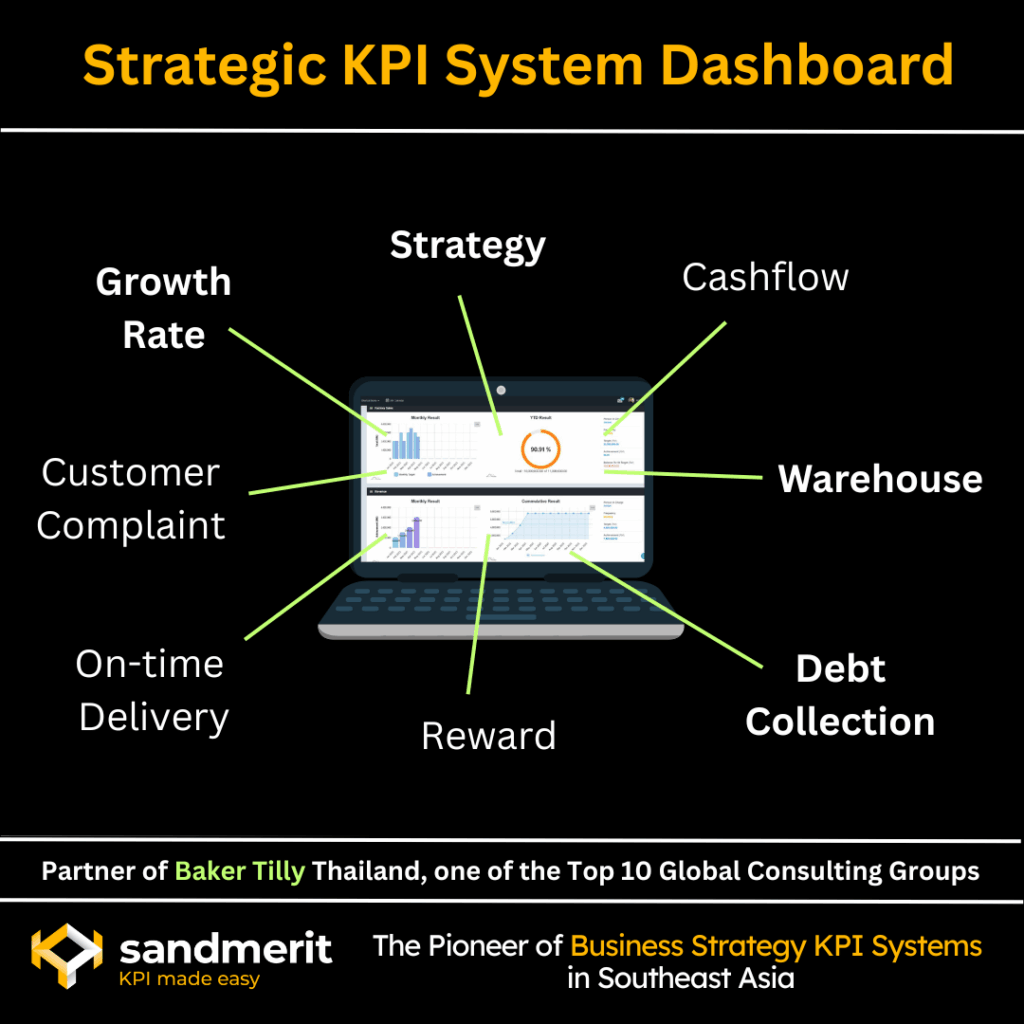
Finally, we implement the sandmerit KPI system so KPI reporting becomes easy and transparent.
Managers can monitor results faster.
Employees can check progress anytime.
HR reduces manual paperwork.
This is how KPI becomes sustainable.
Why Wilson’s Background Makes KPI Implementation Stronger
Wilson Ten is widely known as Malaysia’s KPI King because he has spent more than 23 years focusing on KPI implementation and performance management.
He has guided companies across SMEs, multinational corporations, and public listed companies in Malaysia and Southeast Asia.
Wilson is also the Chairman of the Professional Committee of International KPI Standards, contributing to KPI standards and best practices across the region.
What makes Wilson different is his hands-on approach:
- he coaches CEOs directly
- he aligns business strategy with KPI execution
- he builds practical KPI frameworks across departments
- he focuses on fairness, transparency, and real results
This is why companies don’t just “learn KPI” with sandmerit.
They implement KPI successfully.
Conclusion: The Best Managers Are Built with the Right KPI System
If you are searching for key performance indicators for managers, don’t just look for a KPI list.
Look for a KPI system that creates:
- clarity
- accountability
- fairness
- productivity improvement
- stronger leadership culture
Because KPI is not about controlling people.
KPI is about helping people win.
And when managers win, the company wins.
That is what sandmerit KPI 123 is built to deliver.
#keyperformanceindicatorsformanagers #keyperformanceindicators #kpi #kpimanagement #performancemanagementsystem #productivity #leadership #management #managerkpi #employeeengagement #companyculture #businessstrategy #kpisystem #sandmerit #KPIKing #wilsonten #hrtech #performance #kpiimplementation #ceocoaching #teamperformance #continuousimprovement