
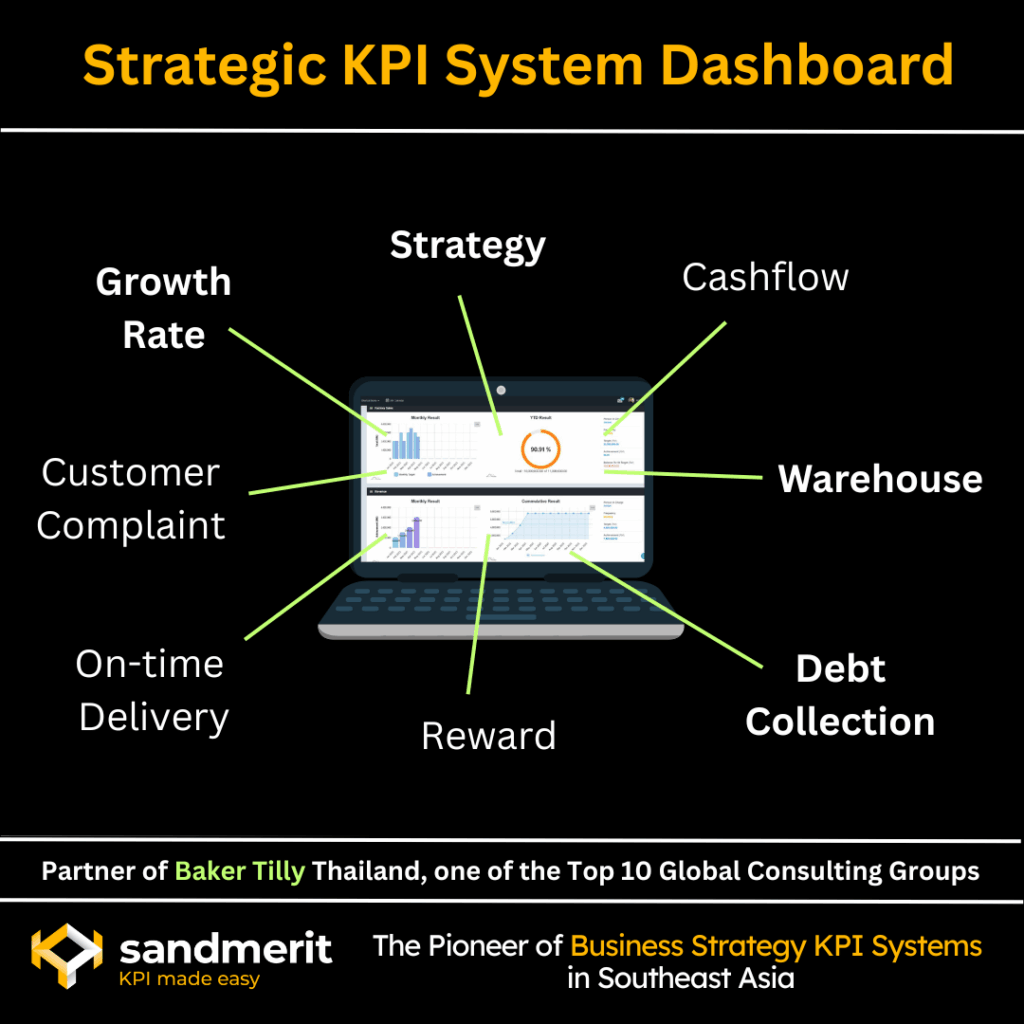
In an era where every business function is expected to justify its contribution, marketing can no longer rely on creativity alone. CEOs today want clarity, predictability, and measurable returns. This is why key performance indicators for marketing manager have become a critical foundation for modern performance management. When designed and implemented correctly, these KPIs turn marketing from a perceived cost center into a strategic growth engine.
Yet many organizations still struggle. Marketing managers are busy running campaigns, creating content, managing agencies, and chasing deadlines, but management still asks a simple question: “Is marketing really working?” The answer becomes unclear when KPIs are vague, disconnected, or poorly executed.
This article explores how key performance indicators for marketing manager should be designed, why most KPI initiatives fail, and how sandmerit KPI 123 offers a fundamentally different and more effective approach.
The Real Role of a Marketing Manager Today
A marketing manager is no longer just responsible for promotions or branding. The role now includes:
- Translating business strategy into market execution
- Generating qualified demand and supporting sales growth
- Building long-term brand value
- Optimizing marketing spend and productivity
- Aligning cross-functional teams around common goals
Without clear key performance indicators for marketing manager, this role becomes overwhelming and subjective. Different stakeholders have different expectations, leading to confusion, conflict, and burnout.
KPIs create alignment. They define priorities and set clear boundaries on what matters most.
Why Key Performance Indicators for Marketing Manager Often Fail
Despite good intentions, many KPI systems fail to deliver results. Common reasons include:
- KPIs are copied from templates without strategic context
- Metrics focus on activity rather than impact
- Targets are unrealistic or disconnected from resources
- Evaluation depends on subjective opinions
- KPI results are not linked to rewards or consequences
When this happens, marketing managers start to see KPIs as a burden rather than a support system. Over time, KPIs become a “reporting exercise” instead of a performance driver.
The problem is not the concept of KPIs, but how they are implemented.
Designing Effective Key Performance Indicators for Marketing Manager
Effective KPIs must be strategic, measurable, and actionable. They should answer three critical questions:
- Does this KPI support business strategy?
- Can the marketing manager influence the result?
- Is the measurement objective and data-driven?
In practice, key performance indicators for marketing manager should cover multiple perspectives.
Business and Financial Perspective
This includes KPIs such as marketing-generated revenue, cost per acquisition, return on marketing investment, and pipeline contribution. These indicators align marketing directly with profitability.
Customer and Market Perspective
KPIs such as brand awareness, engagement rate, customer acquisition growth, and retention metrics reflect how well marketing resonates with the target market.
Internal Process Perspective
Execution KPIs like campaign delivery accuracy, lead quality, and collaboration efficiency ensure that marketing operations remain disciplined and scalable.
Learning and Growth Perspective
This includes innovation, skill development, and system adoption, ensuring that the marketing function continues to evolve.
When these perspectives are balanced, KPIs drive both short-term results and long-term sustainability.
KPI Is Not the Problem, Execution Is
Many companies believe KPI failure is due to employee resistance. In reality, resistance often comes from poor execution. Marketing managers are willing to be measured, but they want fairness, clarity, and transparency.
If KPI scores depend on opinions, mood, or politics, trust collapses. If KPIs change every few months, employees lose direction. If KPI results do not translate into meaningful rewards or recognition, motivation disappears.
This is where most solution providers fall short.
How sandmerit KPI 123 Is Fundamentally Different
sandmerit KPI 123 was designed specifically to solve execution failure. It is not a generic KPI software and not a classroom-style training program. It is a complete execution system.
The difference lies in its three-stage methodology.
Stage 1: CEO-Centric Strategy and Direction
sandmerit begins with the CEO, not the system. Business vision, strategic priorities, and reward philosophy are clarified first. This ensures that key performance indicators for marketing manager are aligned with where the company is heading, not just marketing trends.
Stage 2: Deep Team Alignment and Buy-In
Instead of imposing KPIs, sandmerit conducts hands-on workshops where marketing managers and team members understand how KPIs work, how scores are calculated, and how rewards are linked. This removes fear, builds trust, and increases ownership.
Stage 3: System Automation and Data Discipline
KPIs are automated inside the sandmerit system. Data replaces opinions. Scores are calculated consistently. Marketing managers can focus on execution instead of arguing about evaluation.
Most competitors either sell software without consulting or provide training without systems. sandmerit integrates strategy, people, and technology into one seamless framework.
The Wilson Factor: Experience That Cannot Be Copied
The effectiveness of sandmerit is deeply rooted in the experience of its founder, Wilson Ten. Known as the KPI King in Malaysia, Wilson brings more than 22 years of hands-on experience in performance management across SMEs, public-listed companies, and multinational corporations.
Wilson has personally worked with marketing managers, CEOs, and leadership teams across different industries and countries. His experience goes beyond KPI theory. He understands human behavior, organizational resistance, leadership commitment, and execution psychology.
This is why sandmerit does not treat key performance indicators for marketing manager as isolated metrics. They are positioned as a leadership and communication tool that aligns expectations and behavior.
A Human-Centered KPI Philosophy
What truly differentiates sandmerit is its philosophy. KPIs are not designed to control people. They are designed to create fairness, transparency, and motivation.
Marketing managers clearly understand what is expected. Employees know how performance translates into rewards. CEOs gain peace of mind because performance data is reliable and aligned with profitability.
This human-centered approach explains why sandmerit enjoys strong client loyalty and long-term partnerships.
From Marketing Effort to Marketing Impact
When key performance indicators for marketing manager are implemented correctly, the transformation is powerful. Marketing managers become more focused. Teams align better with business goals. Discussions shift from opinions to data. Rewards feel fair. Performance becomes sustainable.
sandmerit KPI 123 enables this transformation by ensuring that KPIs are not just designed, but lived and executed daily.
Conclusion
Key performance indicators for marketing manager are essential for any organization that wants clarity, accountability, and growth. However, KPIs alone are not enough. Without leadership commitment, team alignment, and system automation, KPI initiatives will fail.
sandmerit KPI 123, guided by Wilson’s deep experience and a proven execution framework, offers a practical and sustainable solution. It turns KPIs from theoretical concepts into real drivers of performance, profitability, and trust.
In a competitive market, execution makes the difference. And the right KPI system makes execution possible.
#keyperformanceindicatorsformarketingmanager #KPI #sandmerit #KPIKing #wilsonten