
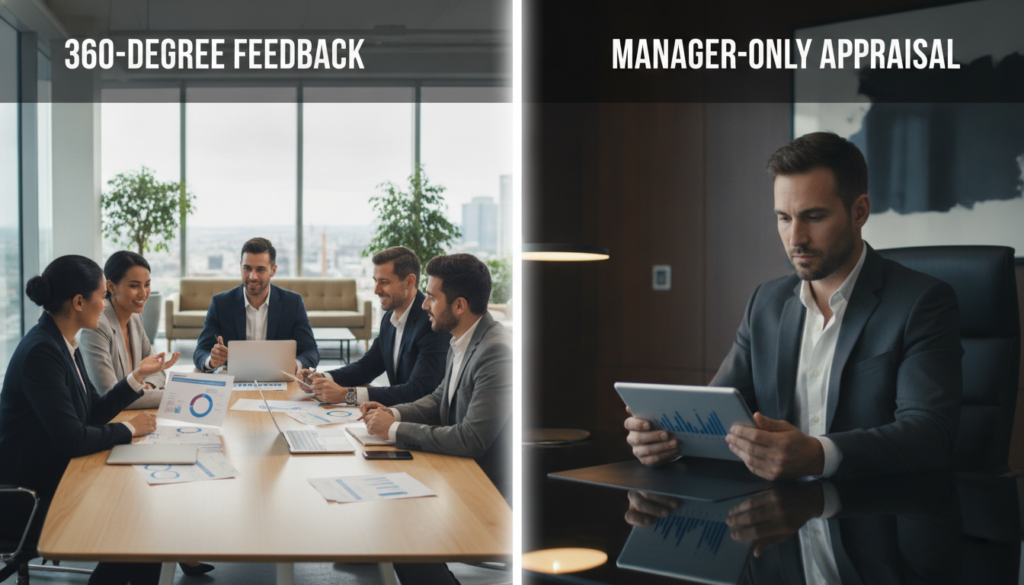
Choosing the right evaluation method is vital for organizational growth. I often see HR leaders struggle to decide between traditional top-down reviews and modern multi-source methods. This choice directly impacts how your team feels and performs every day.
My goal is to provide a clear roadmap for professionals across Malaysia. By analyzing current industry data, I will help you determine which approach aligns with your unique operational needs. Effective evaluation is the cornerstone of long-term success.
Implementing the sandmerit platform allows you to streamline these complex processes with ease. Whether you prefer direct oversight or inclusive peer reviews, our tools support your specific goals. Let us explore how to elevate your workplace culture through better data.
Key Takeaways
- Understand the core differences between traditional and modern review methods.
- Learn how evaluation styles influence overall employee satisfaction.
- Discover why the sandmerit platform is essential for modern HR teams.
- Analyze industry trends relevant to the Malaysian business landscape.
- Gain actionable insights to improve your current organizational workflows.
Understanding the Core Philosophy of Performance Appraisals
To truly grasp the value of modern feedback, I believe we must first look at the traditional performance appraisal methods that shaped our current systems. For decades, the primary goal of these reviews was to document past behavior and justify compensation decisions. This approach often felt like a rigid, backward-looking exercise rather than a tool for growth.
As the workplace changes, so does our approach to employee performance. Organizations are now moving away from simple documentation toward a more dynamic, forward-thinking development model. This shift reflects a deeper understanding that human capital is the most valuable asset in any business.
The Traditional Manager-Only Appraisal Model
The classic model relies heavily on a top-down hierarchy where the manager acts as the sole judge of an individual’s work. This method prioritizes control and consistency, ensuring that the supervisor maintains a clear view of their direct reports. However, this structure often limits the scope of the performance evaluation process.
There are several defining characteristics of this traditional approach:
- Centralized Authority: The manager holds all the power in the review process.
- Limited Perspective: Insights are restricted to what the manager observes directly.
- Administrative Focus: The primary goal is often record-keeping rather than coaching.
The Evolution Toward Multi-Source Feedback
In recent years, I have observed a significant transition toward multi-source feedback. This philosophy recognizes that a single manager cannot possibly see every aspect of an employee’s daily contributions. By gathering input from peers, subordinates, and even clients, companies gain a much more accurate picture of employee performance.
This evolution represents a fundamental change in how we perceive workplace contributions. Instead of relying on one person’s opinion, we now value a holistic view that encourages transparency and collaboration. Adopting these modern performance appraisal methods allows leaders to foster a culture where development is continuous and data-driven.
Ultimately, the goal of a modern performance evaluation is to empower individuals to reach their full potential. By embracing diverse perspectives, organizations can move beyond the limitations of the past and build a more resilient, high-performing workforce.
Defining 360-degree feedback vs manager-only appraisal in a performance management system
When designing a performance evaluation framework, the method of data collection serves as the foundation for all subsequent decisions. I believe that clarity in these definitions is the first step toward building a high-performing team. Whether you choose a manager-only appraisal or a more inclusive model, the impact on your company culture is significant.
Key Differences in Data Collection
The primary distinction between these two models lies in the source of the information. In a traditional manager-only appraisal, the supervisor acts as the sole judge of an employee’s output. This creates a direct, vertical flow of information that is easy to manage but potentially limited in scope.
Conversely, 360-degree feedback gathers input from a wider circle, including peers, subordinates, and even external clients. This multi-source approach requires a robust performance management system to aggregate diverse viewpoints into a coherent summary. By collecting data from multiple angles, the organization gains a more comprehensive view of an individual’s professional contributions.
Scope of Perspective and Organizational Impact
The choice of model dictates how employees perceive fairness within the workplace. A manager-only appraisal is often viewed as efficient, yet it may suffer from personal bias or limited visibility into daily tasks. When I analyze these systems, I look for how they influence trust and transparency across the organization.
Implementing 360-degree feedback can foster a culture of accountability, as employees realize their performance is visible to more than just their direct supervisor. This shift often leads to higher engagement, provided the performance management system is designed to handle the complexity of peer reviews. The following table highlights the core differences between these two approaches to performance evaluation.
| Feature | Manager-Only Appraisal | 360-Degree Feedback |
|---|---|---|
| Primary Source | Direct Supervisor | Peers, Subordinates, Managers |
| Data Depth | Limited to Manager’s View | Holistic and Multi-faceted |
| Bias Risk | High (Individual Subjectivity) | Lower (Aggregated Perspectives) |
| Administrative Load | Low to Moderate | High (Requires Coordination) |
The Mechanics of Manager-Only Appraisals
When I examine standard performance appraisal methods, the top-down approach stands out for its simplicity and directness. This model relies entirely on the supervisor to observe, document, and evaluate the contributions of their direct reports. It remains a deeply ingrained practice within many organizations across Malaysia, where clear hierarchies often dictate the flow of professional feedback.
Strengths of the Top-Down Approach
The primary advantage of a manager-only appraisal is the efficiency it brings to the administrative process. Because the evaluation rests on a single individual, the timeline for completion is often shorter and more predictable. Decisions regarding promotions or salary adjustments can be made quickly without the need to aggregate data from multiple sources.
Furthermore, this method provides a clear line of authority that many employees find easy to understand. When one person holds the responsibility for the review, the expectations are usually communicated in a direct manner. This creates a sense of accountability, as the manager is the sole arbiter of the employee’s success during the review cycle.
Common Pitfalls and Bias Risks
Despite its simplicity, relying on a single perspective introduces significant bias in reviews that can undermine the entire process. I have found that managers often struggle with recency bias, where they weigh events from the last few weeks more heavily than the entire year’s performance. This narrow focus can lead to inaccurate ratings that do not reflect the true value of an employee.
Another major risk involves the subjective nature of human judgment. Without input from peers or subordinates, the manager’s personal preferences or unconscious tendencies can easily influence the final score. This lack of diverse data points often results in bias in reviews, which can lead to employee disengagement and a perception of unfairness. Ultimately, these limitations in traditional performance appraisal methods often drive companies to seek more inclusive alternatives to ensure a balanced view of talent.
The Mechanics of 360-Degree Feedback
Adopting a 360-degree feedback system is more than a technical change; it is a cultural transformation. I believe this method represents a departure from traditional, top-down evaluations by inviting input from various levels of the organization. By gathering insights from peers, subordinates, and supervisors, companies can create a more comprehensive view of an individual’s performance.
How Multi-Source Input Enhances Objectivity
The primary strength of this approach lies in its ability to minimize individual bias. When only one person evaluates an employee, personal preferences or limited observations can skew the results. By aggregating data from multiple sources, the system provides a balanced and objective profile of an employee’s strengths and areas for improvement.
This diversity of perspective is essential for boosting workplace productivity. When employees receive feedback from those they interact with daily, the insights are often more actionable and relevant. This collaborative process ensures that performance reviews are grounded in real-world interactions rather than isolated incidents.
Challenges in Implementation and Cultural Readiness
Transitioning to this model requires a high level of trust within the organizational culture. In many hierarchical environments, employees may feel uncomfortable providing honest feedback to their superiors or peers. Without a foundation of psychological safety, the data collected may be superficial or overly cautious.
Organizations must invest time in training staff to provide constructive and meaningful feedback. If the culture is not ready, the process can lead to confusion or resentment rather than growth. Successfully navigating these hurdles is vital for any company aiming to improve workplace productivity through a more transparent and inclusive organizational culture.
Comparing Accuracy and Bias in Performance Reviews
I often find that the biggest hurdle in performance management is the inherent bias in reviews found in traditional models. When a single supervisor holds all the power to evaluate an employee, the process becomes vulnerable to personal preferences and unconscious tendencies. This narrow focus often compromises feedback accuracy, leaving employees feeling that their true contributions remain unseen.
Mitigating Managerial Subjectivity
The manager-only appraisal model frequently suffers from the “halo effect,” where one positive trait overshadows other areas of performance. I believe that by diversifying the input sources, we can effectively neutralize these individual blind spots. Objectivity is not just a goal; it is a necessity for building trust within a team.
When I analyze performance data, I see that 360-degree feedback acts as a powerful corrective tool. It forces a shift away from singular opinions toward a more comprehensive data set. This approach ensures that the final evaluation reflects a broader reality rather than a solitary perspective.
The Role of Peer and Subordinate Perspectives
Incorporating insights from peers and subordinates provides a holistic view that a manager might otherwise miss. Peers often witness daily collaboration and technical problem-solving that remain invisible to leadership. By aggregating this data, organizations create a more defensible and balanced performance record.
This multi-source approach significantly reduces the impact of personal affinity bias in reviews. When multiple voices contribute to the assessment, the final result becomes more representative of the employee’s actual impact. Ultimately, prioritizing feedback accuracy through 360-degree feedback allows modern enterprises to foster a culture of fairness and professional growth.
Impact on Employee Development and Growth
I believe that true employee development stems from a diverse range of perspectives rather than a single source. While traditional systems often rely on a top-down approach, modern organizations are shifting toward models that prioritize continuous learning. This transition is essential for maintaining high levels of workplace productivity in a competitive market.
Coaching Opportunities in Manager-Led Reviews
In a manager-led model, the supervisor acts as the primary coach for the individual. This structure allows for clear alignment between personal goals and organizational objectives. However, I have observed that these reviews often suffer from limited visibility into daily tasks.
Because the manager cannot observe every interaction, the feedback provided may feel incomplete. This can hinder employee performance if the coaching is based on a narrow set of data points. Effective development requires a more comprehensive view to truly unlock potential.
Holistic Development Through Peer Insights
Integrating peer feedback creates a more holistic picture of an individual’s contributions. By gathering input from colleagues, employees gain a better understanding of their impact on team dynamics. This multi-source approach supports long-term growth by highlighting strengths that a manager might overlook.
When I analyze the link between feedback quality and retention, the benefits of this inclusive model become clear. Employees feel more valued when their efforts are recognized by those they work with daily. Consider these key advantages of a balanced feedback strategy:
- Increased self-awareness regarding interpersonal skills and collaboration.
- Faster identification of skill gaps that impact workplace productivity.
- Stronger alignment between individual growth and team success.
- Higher levels of engagement through transparent employee performance tracking.
Ultimately, development is a continuous process rather than a once-a-year event. By fostering a culture that values diverse insights, companies can ensure that employee development remains a top priority throughout the year.
Administrative Efficiency and Resource Allocation
When I look at organizational growth, I see that efficient resource allocation is the backbone of a sustainable performance strategy. Balancing the need for deep insights with the reality of limited time is a common challenge for leaders today. A successful performance evaluation process must be both thorough and manageable to ensure long-term adoption.
Time Investment for Managers
Managers often worry that gathering input from various sources will consume too much of their workday. While it is true that a more comprehensive review requires more initial effort, the long-term gains in feedback accuracy are significant. By streamlining the process, you can reduce the administrative burden while still capturing a complete picture of employee performance.
I recommend setting clear expectations for how much time should be dedicated to these reviews. When managers understand the value of the data they are collecting, they are more likely to prioritize the task. Consistency is key to ensuring that the time invested translates into actionable development plans for your team.
Technology Requirements for Multi-Source Systems
To handle the complexities of modern reviews, relying on manual spreadsheets is no longer sufficient. Implementing specialized performance review software is essential for automating the collection and analysis of data. This technology allows you to scale your processes without increasing the manual workload for your HR department.
A robust system simplifies the logistics of multi-source feedback by automating reminders and tracking completion rates. This ensures that you receive timely input from peers, subordinates, and managers alike. By leveraging the right tools, you can maintain high standards of data integrity while keeping your administrative costs under control.
Ultimately, the goal is to create a system that supports your people rather than hindering them with paperwork. Investing in the right infrastructure today will pay dividends in the form of clearer insights and more engaged employees. Balancing efficiency with quality is not just possible; it is a competitive advantage for any growing organization.
Cultural Considerations for Malaysian Organizations
I have observed that successful performance management in Malaysia hinges on balancing respect for hierarchy with the need for honest dialogue. When we implement new systems, we must consider how our unique organizational culture influences the way employees perceive and act upon feedback. It is not enough to simply adopt a global model; we must tailor our approach to fit the local context.
Navigating Hierarchy and Feedback Sensitivity
In many Malaysian workplaces, there is a strong emphasis on maintaining harmony and respecting seniority. This can sometimes lead to feedback sensitivity, where employees may feel uncomfortable providing critical input to their superiors. If we are not careful, this dynamic can introduce significant bias in reviews, as managers might only hear what they want to hear.
To overcome this, I recommend creating safe channels for communication that respect traditional power structures while encouraging honesty. By using tools like those found at Sigma Assessment Systems, leaders can better understand how to bridge the gap between cultural norms and performance goals. It is essential to frame feedback as a tool for collective growth rather than a personal critique.
Building a Culture of Transparency
Building a culture of transparency requires consistent effort from leadership to model the behavior they wish to see. When managers openly share their own development areas, it signals to the team that vulnerability is a strength. You can leverage platforms like sandmerit to streamline these processes and ensure that data remains objective.
By fostering an environment where constructive input is rewarded, we can minimize the impact of bias in reviews. The following table outlines how we can transition toward a more balanced approach within the Malaysian context.
| Feature | Traditional Approach | Modern Balanced Approach |
|---|---|---|
| Feedback Flow | Top-down only | Multi-directional |
| Communication | Indirect/Avoidant | Transparent/Constructive |
| Bias Risk | High (Subjective) | Low (Data-driven) |
| Cultural Fit | High Hierarchy | Inclusive Hierarchy |
Leveraging sandmerit for Modern Performance Management
I believe that choosing the right technology is the most critical step in transforming your talent management strategy. Many organizations struggle to maintain consistency, but a dedicated performance management system can bridge the gap between goals and actual results. By integrating digital solutions, you ensure that employee development remains a top priority throughout the fiscal year.
Features of the Sandmerit Performance Management System
Sandmerit provides a comprehensive suite of tools designed to simplify complex evaluation workflows. You can easily track performance metrics in real-time, allowing for data-driven decisions rather than relying on guesswork. This platform helps managers maintain clear visibility into team progress while fostering a culture of accountability.
The following table outlines how this software improves your daily operations compared to traditional methods:
| Feature | Manual Process | Sandmerit Software |
|---|---|---|
| Data Tracking | Spreadsheets | Automated Dashboards |
| Review Cycle | Annual Only | Continuous Feedback |
| Goal Alignment | Disconnected | Integrated Tracking |
| Reporting | Time-Consuming | Instant Analytics |
By utilizing this performance review software, you eliminate the administrative burden that often slows down HR departments. It empowers your leaders to focus on coaching and growth instead of manual data entry. This shift is essential for any business aiming to stay competitive in the modern market.
How to WhatsApp Us to Learn More About sandmerit at +60193156508
I invite you to explore how these digital capabilities can be tailored to your specific organizational needs. If you are ready to modernize your approach, our team is here to assist you with a personalized demonstration.
Please feel free to WhatsApp us to learn more about sandmerit Performance Management System at +60193156508. We look forward to helping you build a more efficient and transparent workplace through better technology.
Selecting the Right Strategy for Your Business
Your approach to talent management should evolve alongside your company’s growth and cultural readiness. I find that many leaders struggle because they adopt rigid frameworks that do not match their current operational reality. By carefully evaluating your internal needs, you can build a performance management system that truly supports your long-term goals.
Assessing Organizational Maturity
Before choosing a review model, you must determine where your company stands in its lifecycle. Startups often thrive with informal, manager-led feedback due to their flat structures and rapid pace. However, as you scale, your organizational culture requires more structured data to ensure fairness and clarity.
I recommend conducting a readiness audit to see if your team is prepared for multi-source feedback. If your staff lacks trust or clear communication channels, jumping into a complex 360-degree system might cause friction. Focus on building a foundation of transparency first to ensure your talent management efforts yield positive results.
Hybrid Approaches for Balanced Results
You do not have to choose between a top-down approach and a peer-based model. Many successful Malaysian businesses utilize a hybrid performance management system to capture the best of both worlds. This method allows managers to maintain accountability while incorporating valuable insights from colleagues.
By blending these styles, you foster an organizational culture that values both individual growth and team collaboration. This balanced strategy helps mitigate bias while keeping the administrative burden manageable for your leadership team. Use the following table to identify which approach aligns with your current business stage.
| Business Stage | Primary Focus | Recommended Strategy |
|---|---|---|
| Early Startup | Speed and Agility | Manager-Led |
| Growth Phase | Alignment and Goals | Hybrid Model |
| Established Firm | Development and Culture | Full 360-Degree |
Conclusion
Selecting the right performance management system requires a deep look at your organizational goals. I believe that balancing top-down oversight with multi-source feedback creates a robust framework for success. This shift toward inclusive models directly supports long-term employee development.
Your team thrives when feedback becomes a continuous conversation rather than a yearly event. By integrating diverse perspectives, you gain a clearer picture of individual contributions. This clarity serves as a catalyst for meaningful employee development across all levels of your business.
I invite you to reflect on these strategies to determine the best path for your workforce. Modern tools like Sandmerit offer the flexibility needed to adapt to changing workplace dynamics. Investing in the right system today ensures your organization remains competitive and supportive of every team member.
Your commitment to refining these processes will yield significant rewards in engagement and productivity. I hope these insights provide the guidance needed to foster a culture of growth and transparency. Start your journey toward a more effective performance management strategy today.
FAQ
Why do I recommend a 360-degree feedback model over a traditional manager-only appraisal?
In my professional analysis, I have found that a 360 appraisal provides a much more comprehensive view of an individual’s contributions. While a manager-only appraisal relies on a single point of failure—the supervisor’s perspective—the 360-degree model aggregates data from peers and subordinates. This helps me identify “blind spots” that a manager might miss, leading to more accurate talent development and higher levels of employee engagement across the organization.
How can performance review software mitigate common biases like the halo effect?
I utilize advanced performance review software like sandmerit to neutralize human subjectivity. By collecting diverse data points, the system dilutes the impact of the halo effect, where one positive trait overshadows overall performance. I believe that by using a structured performance management system, organizations can ensure that ratings are based on objective KPI tracking rather than a manager’s personal affinity or recent memory.
What are the primary challenges I see when Malaysian companies transition to multi-source feedback?
From my observations in the Malaysian market, the biggest hurdle is often the existing hierarchical culture. Many employees may feel hesitant to provide honest feedback to their superiors. To overcome this, I emphasize the need for a performance management system that guarantees anonymity. Building a culture of transparency is essential before the full benefits of a 360-degree feedback system can be realized for business growth.
Does implementing a 360-degree feedback system require more administrative resources?
I acknowledge that managing multi-source input manually is nearly impossible for large enterprises. However, I have seen that using a dedicated platform like Sandmerit significantly improves administrative efficiency. The software automates the distribution of surveys and the aggregation of data, allowing HR leaders to focus on strategic talent development rather than chasing paperwork. My goal is to show you that the right technology makes complex evaluations sustainable.
How does the choice of appraisal method impact long-term employee retention?
I have consistently seen that employees are more likely to stay with a company when they feel their evaluations are fair and holistic. By moving away from top-down reviews, I can provide employees with actionable coaching from their peers, which fosters a sense of belonging and increases employee engagement. When I use a 360 appraisal approach, I am investing in the employee’s long-term career path, which is a key driver for retention in competitive markets like Kuala Lumpur and Singapore.
Can I integrate specific KPI tracking into the sandmerit system?
Yes, I highly recommend integrating KPI tracking directly into your performance management system. Sandmerit is specifically designed to align individual goals with organizational objectives. This integration allows me to see not just *how* an employee works (via feedback), but also *what* they have achieved (via quantitative data), creating a balanced and defensible performance record.
How can I learn more about implementing sandmerit in my organization?
I invite you to reach out directly to see how this system can transform your HR processes. You can WhatsApp us at +60193156508 to speak with a consultant at Sandmerit. I am confident that a personalized demonstration will show you how our performance review software can be tailored to meet your specific operational needs and cultural requirements.