
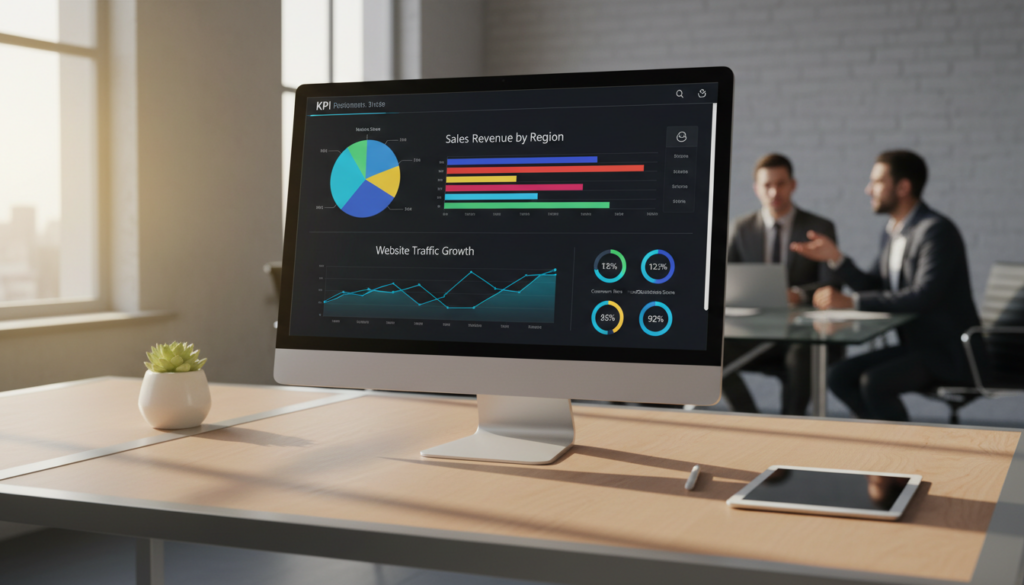
Did you know companies that prioritize their people’s performance are 4.2 times more likely to outperform their peers? This striking fact reveals a simple truth: what gets measured gets managed, and what gets managed gets improved.
In today’s competitive business landscape, guessing your way to success is not a strategy. You need a clear, structured framework to measure what truly matters. This is where a well-defined key performance indicator system becomes your most valuable asset.
We believe the right metrics, tracked consistently, turn ambition into achievement. A robust framework aligns every team’s effort with overarching business goals and strategic objectives. It moves you from reactive management to proactive leadership.
Our guide is designed to provide that clarity. We focus on giving teams the clean data and visual dashboards they need to make informed decisions about their work. This foundational approach streamlines management and drives consistent growth.
Key Takeaways
- A strong performance framework is a proven catalyst for business growth and competitive advantage.
- Clear objectives and aligned goals ensure every project contributes to the bigger picture.
- Accurate tracking of progress over time is essential for understanding what drives results.
- Access to the right data empowers teams to make smarter, faster decisions.
- This foundation is critical for building high-performing teams that improve outcomes like sales.
- Visual dashboards transform complex information into actionable insights for everyone.
- A streamlined management process keeps all initiatives on the correct path forward.
Introduction: Setting the Foundation for Strategic Performance
Without clear direction, even the best teams can drift off course. A strong foundation turns this around. It aligns daily work with your company’s most important aims.
This foundation is built on measurable outcomes, not intuition. As Sean O’Connor noted on October 21, 2025, tracking progress without a consistent system leads to poor results. We provide the structure to avoid that.
Understanding Key Performance Indicators and Their Role
Key performance indicators are the vital signs of your business. They are specific metrics that show if you are hitting your targets. These indicators give managers a clear view of efficiency and project health.
They translate high-level objectives into daily tasks for employees. This ensures everyone understands their role in driving revenue and sales.
To see the difference a strategic approach makes, consider this comparison:
| Aspect | Traditional Approach | Strategic KPI Approach |
|---|---|---|
| Focus | General activity tracking | Measurable outcomes tied to goals |
| Data Clarity | Mixed signals from various sources | Unified insights from a single dashboard |
| Team Alignment | Employees work on isolated tasks | All tasks connect to business objectives |
Our plan helps you select the right indicators. We design systems that make data actionable for all stakeholders. This empowers your team to track improvements and adjust their work.
For More Information, Please WhatsApp to +6910-3156508
Ready to build this foundation? Please WhatsApp to +6910-3156508 for more information. We can show you how to implement a system that drives organizational efficiency and team success.
Understanding the Importance of KPI Templates in Modern Business
Adopting a standardized framework for tracking outcomes is no longer a luxury but a core business necessity. In a competitive landscape, consistent measurement separates thriving companies from the rest.
Research confirms this. Firms that prioritize their people’s performance are 4.2 times more likely to outperform peers. A well-designed kpi template is the engine for this success. It turns intention into measurable action.
Aligning Metrics with Business Goals
Our process starts by linking every metric directly to your core business goals. This ensures your team’s daily work consistently drives revenue and growth. Without this alignment, effort is wasted.
Standardized templates help managers track project progress with clarity. They give internal teams a unified view of their performance. This saves valuable time and simplifies complex reporting.
A consistent dashboard monitors key indicators across departments. It provides real-time data for smarter decisions. This allows leaders to adjust their plan based on actual trends, not guesses.
Ultimately, a strong framework aligns all activities with strategic objectives. It ensures every project milestone is met on time. This is how modern businesses build a culture of accountability and continuous improvement.
Key Components of an Effective Performance Template
A powerful performance framework is built on two core pillars: actionable metrics and clear targets. These elements turn a simple document into a strategic tool for growth.
We identify fifteen marketing key performance examples that span the entire customer journey. This ensures your system captures every critical phase, from awareness to conversion.
Identifying and Defining Actionable Metrics
The right metrics show real progress. They allow managers to track project results and sales activities with precision.
We help you select indicators your team can actually influence. This avoids vanity metrics that offer no real decision-making value.
Focus on data that drives revenue and meets business objectives. A good dashboard provides the insights needed to monitor these areas effectively.
Establishing Clear Performance Targets
Clear targets give every employee a defined role. They understand how their work achieves the revenue goals set by leadership.
We recommend tracking five to seven kpis per template. This maintains focus and prevents overwhelming your teams.
Our approach uses historical data to create a realistic plan. Targets should challenge your people without causing stress or burnout.
This method ensures consistent performance across different project groups. It aligns all efforts with your top-level business aims.
Building Your kpi template for Success
Building a dynamic measurement system starts with a clear, repeatable methodology tailored to your unique needs. Moving from theory to practice requires a structured approach. We guide you through this essential construction phase.
Our method ensures your final tool drives real business growth. It turns strategic objectives into a living plan for your teams.
Step-by-Step Process to Create a Tailored Template
First, we align every metric with your core business goals. This ensures your dashboard tracks what truly matters for success.
Next, we select actionable indicators your managers can influence. We avoid vanity metrics that don’t drive decisions.
Setting realistic targets comes third. We use historical data to challenge your team without causing stress.
Then, we leverage platforms like monday work management. Its support for DMAIC templates provides a proven framework for continuous improvement.
Finally, we build the visual dashboard. This gives everyone real-time insight into project progress and resource allocation.
Customizing Templates for Various Departments
A one-size-fits-all approach fails. Your marketing department needs different indicators than your sales team.
We customize each template to monitor specific departmental goals. This keeps the primary business focus sharp for all.
Involving employees in the design increases accountability. It also ensures the metrics are relevant to their daily work.
Using a flexible template allows easy adjustments. As business objectives shift, your plan stays agile and efficient.
Our experts provide the resources to build a robust system. You get a dashboard that captures the most important data for your specific project needs.
Leveraging Dashboard Templates for Real-Time Performance Tracking
The power of a live dashboard lies in its ability to turn raw numbers into clear, actionable stories. This real-time visibility is crucial for modern business management.
It allows leaders to monitor progress and guide their team with confidence. Dynamic visuals ensure everyone understands the data.
Visualizing Data Through Dynamic Charts and Graphs
Charts and graphs transform complex metrics into understandable insights. This visual approach is highly effective.
Research shows 80% of Millennials believe AI can improve their work through better data visualization. Our tools make this a reality.
Interactive elements let users drill down into specific performance indicators. This fosters a deeper understanding of what drives results.
Benefits of Automated and Customizable Dashboards
Automation is a game-changer. It saves time and reduces errors in reporting.
Your team can track targets and take immediate actions when needed. This agility is a key competitive advantage.
Customizable dashboards provide unique value for different departments. A marketing team needs different views than a sales group.
Consider the impact of moving from manual to automated systems:
| Aspect | Manual Reporting | Automated Dashboard |
|---|---|---|
| Data Freshness | Days or weeks old | Real-time updates |
| Time Spent | High, on compilation | Low, focused on analysis |
| Insight Accuracy | Prone to human error | Consistently reliable |
| Customization | Limited, static | High, user-driven |
Using a robust dashboard template ensures you monitor the right number of critical project tasks. This keeps all teams aligned with strategic goals.
For advanced functionality, explore integrated performance software. This tool streamlines tracking and empowers your entire organization.
Best Practices for Continuous KPI Tracking and Improvement
Continuous improvement in organizational performance hinges on avoiding common management traps. Research confirms that firms prioritizing their people’s performance are 4.2 times more likely to outperform peers. Sustaining this edge requires a disciplined, ongoing process.
Avoiding Common Pitfalls in KPI Management
We recommend a quarterly review of your measurement framework. This ensures metrics stay aligned with evolving business goals. It prevents your team from chasing outdated targets.
Avoid vanity metrics that offer no real insight. Focus on indicators that drive actionable decisions for your project and sales teams. This sharpens focus and boosts efficiency.
Tracking too many kpis is a frequent mistake. It dilutes attention and overwhelms managers. We help you select a concise set that reflects true progress.
Involve your team in choosing their metrics. This fosters ownership and improves data quality. Regular review cycles allow you to discuss results and adjust the plan.
A well-maintained dashboard is essential. It provides real-time visibility into performance over time. This keeps every project on the correct path.
By following these practices, you build a culture of continuous improvement. Every employee becomes motivated to achieve their objectives.
Integrating Technology and Tools for Advanced KPI Monitoring
Real-time decision-making is powered by a unified view of performance across all departments. Moving from manual tracking to an integrated technology stack is the next critical step.
This integration connects your business systems into a single, actionable dashboard. It turns scattered data into coherent insights.
Implementing Automation for Real-Time Insights
We use platforms like monday work management to automate your kpi template. Its support for DMAIC templates provides a proven framework.
Automation ensures every performance indicator updates accurately and on time. It reduces manual work for your management and project teams.
You can monitor a larger number of metrics without increasing workload. Automated alerts notify your team when a specific kpi falls below its target.
Connecting Systems to Create a Unified Data Ecosystem
Our approach builds a unified data ecosystem. It connects your marketing and sales tools to track revenue and project results.
This creates a seamless view across all business areas. Employees can track their progress and take actions that drive business value.
We provide the resources to connect your existing tool set. The result is a robust performance monitoring system.
Key benefits of this integration include:
- Reduced manual reporting and error.
- Faster response to key performance trends.
- Alignment of all teams with strategic goals.
- Empowered employees achieving their targets.
This system empowers your team to drive sustainable growth. It transforms how you monitor critical kpis.
Conclusion
Ultimately, sustainable growth stems from a culture of informed decision-making and aligned effort. We have explored how a powerful kpi template provides the structure to transform ambition into consistent results.
Selecting the right indicators and utilizing a robust dashboard allows your team to track progress toward clear business goals. This clarity is the foundation for long-term success.
We encourage you to implement these templates across your organization. Our guide has outlined the steps to build a performance management system that empowers your teams.
Consistent tracking and data-driven choices maintain a competitive edge. By focusing on actionable metrics, you ensure every project and team member remains motivated and aligned with what matters most.
FAQ
What is the primary purpose of a KPI template?
The main purpose is to provide a consistent framework for defining, tracking, and communicating progress toward our most critical goals. It ensures everyone on our team focuses on the same actionable metrics and understands what success looks like.
How do we ensure our metrics align with broader business goals?
We start by clearly defining our strategic objectives. Then, we work backward to select indicators that directly measure progress toward those aims. This creates a clear line of sight from daily activities to overall company success.
What are the most important elements to include in our performance tracking system?
A> An effective system includes clearly defined metrics, specific and measurable targets, a reliable data source, a set reporting frequency, and a designated owner responsible for each result. This structure turns data into accountable action.
How can different departments use the same foundational template?
While the core structure remains consistent—linking metrics to goals—each unit customizes it with department-specific targets. For example, marketing might track lead conversion, while operations monitors production efficiency, all supporting the same business plan.
What are the benefits of using a dashboard for this process?
Tools like Tableau or Google Looker Studio transform raw numbers into visual charts and graphs. This provides real-time insights, highlights trends instantly, and allows every stakeholder to understand performance at a glance, fostering faster and better decisions.
What is a common mistake to avoid when managing these indicators?
A frequent pitfall is tracking too many metrics, which dilutes focus. We prioritize quality over quantity, selecting only the most vital signs of health and progress that truly drive our strategic priorities forward.
How does technology improve our monitoring capabilities?
Automation tools connect data from various systems—like sales CRMs and financial software—into a single dashboard. This eliminates manual reporting work, provides real-time visibility, and creates a unified ecosystem for advanced analysis.