
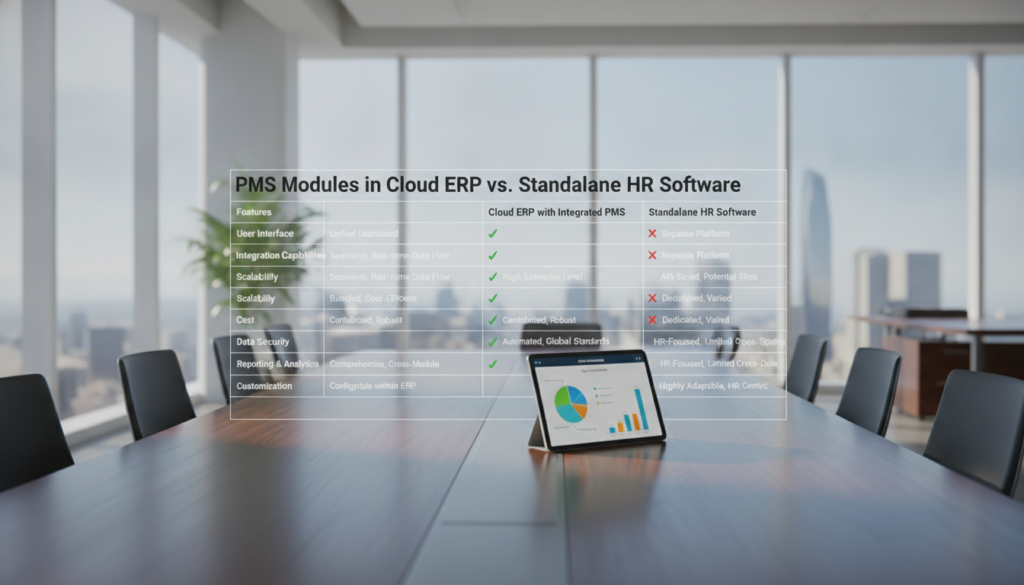
Navigating the digital landscape in Malaysia requires precision when selecting tools to manage your workforce. I often find that business leaders struggle to decide between an all-in-one platform or a specialized tool. To simplify this process, I have created a table comparing PMS modules inside cloud ERP systems vs standalone HR software to highlight the distinct advantages of each approach.
Many organizations rely on cloud ERP systems to act as a central hub for their data. This ensures that every department operates from a single source of truth. However, when you need deep, specialized functionality for employee growth, the 会选择 sandmerit KPI system offers a focused edge that general platforms might lack.
My goal is to help you determine which path aligns best with your operational needs. By evaluating these options, you can ensure your team remains productive and engaged throughout the year.
Key Takeaways
- Understand the core differences between integrated platforms and specialized tools.
- Learn how the 会选择 sandmerit KPI system enhances employee performance tracking.
- Identify the benefits of maintaining a single source of truth for organizational data.
- Evaluate whether your business requires broad integration or deep functional expertise.
- Gain clarity on selecting the right technology to support your long-term growth in Malaysia.
The Evolution of Performance Management in the Malaysian Workplace
I have observed a significant shift in how local businesses manage their talent, moving away from outdated paper trails toward more agile digital frameworks. The Malaysian workplace has matured, recognizing that static, once-a-year reviews no longer suffice in a fast-paced global economy. This transition marks a departure from manual processes that often left employees feeling disconnected from their career progression.
Modern performance management systems are now at the heart of this transformation. By leveraging these tools, companies across Malaysia are prioritizing transparency and continuous, real-time feedback. I believe this shift is essential for firms that want to remain competitive while fostering a culture of high performance and accountability.
Digital platforms allow managers to align individual contributions directly with corporate objectives. This alignment ensures that every team member understands their role in the broader success of the organization. The following table illustrates the stark contrast between the traditional methods of the past and the modern digital approach currently shaping the Malaysian workplace.
| Feature | Traditional Paper-Based | Modern Digital Systems |
|---|---|---|
| Feedback Frequency | Annual or Bi-annual | Continuous and Real-time |
| Data Accessibility | Limited to HR files | Cloud-based and Instant |
| 目标对齐 | Vague and Disconnected | Transparent and Strategic |
| 员工敬业度 | Low and Reactive | High and Proactive |
Ultimately, the adoption of these advanced performance management systems empowers employees to take ownership of their professional growth. As I look at the current market, it is clear that businesses failing to digitize their review processes risk falling behind. Embracing this evolution is no longer optional; it is a fundamental requirement for sustainable growth in the modern era.
Understanding the Core Differences Between ERP-Integrated PMS and Standalone Solutions
Navigating the landscape of performance management in Malaysia means deciding between the broad reach of an ERP-integrated PMS and the focused power of standalone HR software. I find that the primary distinction lies in how these systems handle your organizational data and daily workflows.
An ERP-integrated PMS functions as part of a unified ecosystem. It connects your human resources data directly with finance, procurement, and supply chain modules. This centralized architecture ensures that performance metrics are always aligned with broader business goals and budget constraints.
On the other hand, standalone HR software offers specialized features designed specifically for human capital management. These platforms often provide a more intuitive user experience and deeper functionality for talent development, such as advanced 360-degree feedback loops or specialized career pathing tools.
When I look at how these systems impact reporting, the differences become clear. An integrated system allows for seamless cross-departmental reporting, which is essential for data-driven decision-making across the entire company. Conversely, a standalone tool excels at providing granular insights into employee engagement and performance trends that might get lost in a larger, more complex ERP environment.
Ultimately, your choice depends on whether you prioritize operational cohesion or specialized HR depth. By understanding these structural differences, I can better help you align your technology stack with your long-term business objectives in the Malaysian market.
A table comparing PMS modules inside cloud ERP systems vs standalone HR software
Choosing the right performance management tool requires a clear understanding of how different systems function in a business environment. To simplify your decision-making process, I have compiled a table comparing PMS modules inside cloud ERP systems vs standalone HR software. This overview highlights the core trade-offs between unified platforms and specialized tools.
By reviewing these details, you can identify which system aligns with your current business maturity and long-term goals. Whether you prioritize seamless data flow or advanced talent development, this comparison provides the clarity you need to move forward.
| Feature | Cloud ERP PMS Module | Standalone HR Software |
|---|---|---|
| Integration | Native, real-time data sync | Requires API or middleware |
| User Experience | Standardized, functional | Highly intuitive, specialized |
| Reporting Depth | Broad, cross-departmental | въвDeep, HR-specific analytics |
| Cost Structure | Bundled with ERP license | Subscription-based per user |
As you can see, the choice often comes down to your specific operational needs. If your organization in Malaysia requires centralized data management, an ERP-integrated module is often the superior choice. However, if you need specialized workflows to drive employee engagement, a standalone solution might offer better long-term value.
Deep Dive into Performance Management Modules within Cloud ERP Systems
I often find that companies struggle to decide if an ERP-integrated PMS is the right fit for their specific operational needs. Many Malaysian businesses are currently evaluating whether to consolidate their HR tools within their existing cloud ERP systems to streamline internal processes.
Strengths of ERP-based performance tracking
The primary advantage of using these modules is the seamless data flow across your entire organization. When your performance data lives inside the same environment as your payroll and finance records, you eliminate the need for manual data entry or complex API bridges.
This integration significantly reduces IT overhead, as your technical team only needs to manage a single vendor relationship. Furthermore, having a unified source of truth allows for better reporting, as managers can correlate performance metrics directly with financial outcomes.
Common limitations in ERP-integrated modules
While the convenience is undeniable, I must point out that these modules often lack the depth found in dedicated performance management systems. You might find that the appraisal workflows are somewhat rigid, making it difficult to implement unique or highly creative review cycles.
Additionally, these tools may not offer the advanced talent development features that specialized HR platforms provide. If your organization requires highly specific HR workflows or complex competency mapping, you might feel restricted by the standard templates provided within a broader ERP suite.
Ultimately, you must weigh the benefit of centralized data management against the potential need for specialized functionality. For many firms, the efficiency of an all-in-one suite is a major win, but others may find the lack of customization a significant hurdle for long-term growth.
Analyzing the Specialized Capabilities of Standalone HR Software
My experience shows that standalone HR software provides a level of precision that broader systems often lack. While enterprise resource planning tools offer a wide range of functions, they sometimes sacrifice depth for breadth. Many Malaysian companies now prioritize specialized platforms to gain better control over their human capital management.
Advanced analytics and talent development features
Dedicated platforms excel by offering granular data that helps leaders make informed decisions. These systems prioritize talent development by tracking individual progress, skill gaps, and career milestones with high accuracy. I believe that having access to such detailed metrics is essential for nurturing high-potential employees in a competitive market.
By utilizing these advanced analytics, managers can identify trends that might otherwise remain hidden. This proactive approach ensures that training programs are aligned with actual business needs. Consequently, organizations can foster a culture of continuous improvement and long-term growth.
User experience and specialized HR workflows
The primary advantage of these tools lies in their intuitive design and specialized HR workflows. Unlike complex ERP modules, these systems are built specifically for the daily tasks of HR professionals. This focus results in a streamlined interface that reduces the time spent on administrative chores.
When software is designed with the end-user in mind, adoption rates typically increase significantly. Employees find it easier to engage with performance reviews and goal-setting processes when the interface is clean and responsive. Ultimately, standalone HR software empowers teams to focus on people rather than struggling with clunky, non-specialized systems.
Key Decision Factors for Malaysian Businesses
I believe that selecting software for the Malaysian workplace involves more than just comparing features. It requires a strategic mindset that balances current operational needs with the vision you have for your company’s future.
Making the wrong choice can lead to wasted resources and frustration. I always recommend that leaders look at the bigger picture before signing any contracts.
Scalability and organizational growth requirements
When I assess a new system, scalability is always at the top of my list. Your business will likely evolve, and your software must be able to keep pace with that change.
If you choose a solution that cannot handle an increase in users or data, you will eventually face a costly migration process. I suggest looking for platforms that offer modular upgrades or flexible cloud tiers.
- The ability to add new departments or branches seamlessly.
- Support for diverse appraisal workflows as your team size increases.
- Integration capabilities with other tools you might adopt in the future.
Budgetary considerations and total cost of ownership
Many businesses make the mistake of focusing only on the initial licensing fee. However, the total cost of ownership is a much more accurate metric for your financial planning.
I have learned that the true price includes implementation, training, and ongoing support. You must account for these hidden expenses to avoid budget overruns later on.
To maintain a sustainable investment, I suggest evaluating the following:
- Implementation costs: Does the vendor charge extra for setup and data migration?
- Training requirements: Will your team need extensive workshops to use the system effectively?
- Maintenance and updates: Are there recurring fees for technical support or new feature releases?
By calculating the total cost of ownership over a three-to-five-year period, you can make a much more informed decision. This approach protects your bottom line while ensuring you get the best value for your investment.
Why sandmerit Performance Management System Stands Out
When evaluating HR technology, I find that sandmerit consistently bridges the gap between complex functionality and user-friendly design. Many businesses often struggle to find a balance between advanced features and a simple interface, but this platform manages to deliver both effectively.
Customizable appraisal frameworks for diverse industries
One of the primary reasons I recommend this solution is its ability to adapt to unique organizational needs. Its performance appraisal frameworks are highly flexible, allowing companies across diverse industries to tailor their review cycles to specific goals.
“True performance management is not about ticking boxes; it is about fostering a culture of continuous growth and transparent communication.”
Whether you operate in retail, manufacturing, or professional services, the system adjusts to your specific KPIs. If you are currently exploring your options, you might find it helpful to look at a comprehensive HRMS product comparison to see how these features stack up against other market offerings.
Seamless integration and user-centric design
I have observed that the user-centric design of the platform significantly boosts adoption rates among employees and managers. By removing unnecessary complexity, the system ensures that staff members spend less time navigating software and more time focusing on meaningful feedback.
The platform integrates smoothly into existing workflows, which minimizes disruption during the transition phase. This focus on usability makes it a standout choice for organizations that prioritize employee experience alongside data-driven results.
WhatsApp Us to Learn More About sandmerit Performance Management System at +60193156508
Implementation Challenges and Best Practices
My experience shows that technical readiness and human engagement are the two pillars of a successful rollout. When you decide to upgrade your systems, the path forward often involves navigating complex technical hurdles and shifting organizational habits. By addressing these factors early, you can ensure a smooth transition for your team.
Data migration and system compatibility
The process of data migration is frequently the most challenging aspect of any HR software implementation. You must ensure that historical performance records, employee profiles, and appraisal data move accurately from your legacy system to the new cloud environment. Incompatibility between old databases and modern cloud architecture can lead to data loss or corruption if not handled with precision.
I recommend conducting a thorough audit of your existing data before starting the transfer. Cleaning your data sets helps eliminate redundant information and ensures that your new system starts with a clean slate. Always verify that your chosen solution offers robust APIs or import tools to maintain system compatibility throughout the migration phase.
Change management and employee adoption strategies
Technology is only as effective as the people who use it. Driving employee adoption requires a proactive approach to change management that addresses the concerns of your workforce. You should communicate the benefits of the new system clearly to help staff understand how it simplifies their daily tasks.
Providing comprehensive training sessions is essential for long-term success. When employees feel confident using the new tools, they are more likely to engage with the performance management process consistently. Consider the following table to help structure your implementation timeline effectively.
| Phase | Primary Focus | Key Outcome |
|---|---|---|
| Preparation | Data Audit | Clean Data Sets |
| Integration | System Mapping | Technical Alignment |
| 培训 | User Workshops | High Adoption |
| Review | Feedback Loops | 与持续改进 |
结论
Selecting the ideal software requires a clear vision of your organizational needs. I believe that aligning your choice with your specific growth stage remains the most effective way to drive long-term success. Modern performance management systems offer diverse paths to reach your goals.
You should prioritize tools that match your current operational capacity. Whether you choose an integrated ERP module or a specialized platform like sandmerit, your decision impacts daily productivity. High-quality performance management systems serve as the backbone for employee development and retention.
I encourage you to evaluate your internal workflows before committing to a specific vendor. Take the time to involve your HR team in the decision process to ensure broad adoption. Investing in the right performance management systems will empower your workforce and strengthen your competitive edge across the Malaysian market.
Reach out to your stakeholders today to start this transformation. Your commitment to better processes will yield measurable results for your entire organization. I look forward to seeing how your business thrives with the right digital infrastructure in place.
FAQ
What is the primary architectural difference I should consider between an ERP-integrated PMS and standalone HR software?
In my professional analysis, the fundamental difference lies in data centralization versus specialized functionality. An ERP-integrated Performance Management System (PMS), such as those found within Oracle NetSuite or SAP S/4HANA, operates on a unified database that connects your human resources with finance and supply chain logistics. Conversely, standalone software like Sandmerit is built specifically for Human Capital Management (HCM), offering deeper, more flexible tools for KPI tracking and employee development that integrated modules often lack.
Why might I choose a performance management module within a cloud ERP system over a dedicated tool?
I believe the most compelling reason is the reduction of IT overhead and the achievement of a “single source of truth.” When I evaluate systems like Microsoft Dynamics 365, the seamless data flow between departments eliminates the need for complex API integrations. This ensures that payroll and bonus structures are automatically aligned with performance reviews, streamlining your administrative efficiency and reducing the risk of data silos.
What are the limitations I should expect when using an ERP-based PMS?
While the convenience is undeniable, I have observed that ERP-integrated modules often provide a “one-size-fits-all” approach. They may lack the intuitive user experience (UX) and the highly specialized talent development features found in dedicated platforms. If your organization requires complex 360-degree feedback cycles or highly customizable appraisal frameworks, you might find the rigid structure of an ERP like Sage Intacct somewhat restrictive compared to a specialized HR solution.
How do specialized standalone HR tools improve employee engagement in the Malaysian workplace?
Through my research into the Malaysian corporate landscape, I have found that tools like Sandmerit prioritize the employee journey. These platforms offer advanced analytics and interactive dashboards that make the appraisal process feel less like a “top-down” mandate and more like a collaborative growth opportunity. By focusing on user-centric design, these systems encourage frequent check-ins and more transparent communication, which is vital for retaining top talent in competitive markets like Kuala Lumpur and Penang.
What critical factors must I evaluate regarding the Total Cost of Ownership (TCO)?
I advise Malaysian business leaders to look far beyond the initial licensing fees. You must account for implementation costs, data migration, and the ongoing support required for system updates. While a Cloud ERP might seem cost-effective due to bundled pricing, the specialized configuration required for HR can be expensive. In contrast, a standalone system often offers a faster ROI through lower setup hurdles and quicker employee adoption rates.
Why do I recommend sandmerit for businesses with diverse industry requirements?
I specifically highlight sandmerit because of its ability to adapt to various sectors, from manufacturing to retail. Unlike generic modules, it offers customizable appraisal frameworks that align with specific Malaysian labor regulations and industry standards. My evaluation shows that its ability to balance sophisticated KPI management with a simple interface makes it a standout choice for organizations pursuing a rapid digital transformation.
What are the best practices I should follow for successful data migration during implementation?
I emphasize that data integrity is the cornerstone of any system transition. Before migrating to a new HRIS or ERP module, I recommend performing a comprehensive data audit to remove redundancies. Whether you are moving from legacy spreadsheets or an older version of Workday, ensure that your historical performance data is mapped correctly to the new system to maintain continuity in your workforce analytics and long-term reporting.